
Category: Journal
Gamma brain activity before death and personality change
Universal Declaration of Human Values: Article 12 – Due Process – Innocent Until Proven Guilty
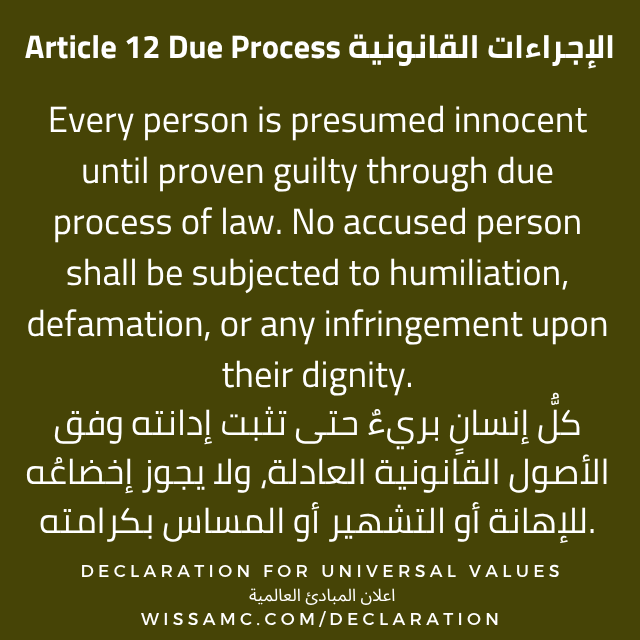
A just society is not defined by how it treats the popular, the powerful, or the innocent; it is defined by how it treats those who stand accused. Article 12 affirms one of the most fundamental principles of justice: every person charged with an offense is presumed innocent until proven guilty through a fair and lawful process. The burden of proof rests entirely upon the accuser, not the accused. No individual should be required to prove their innocence, for liberty itself depends upon the principle that guilt must be established by evidence, not assumed by suspicion, rumor, public opinion, or government accusation.
This principle emerged from centuries of struggle against arbitrary power. In many societies throughout history, accusation alone was often enough to destroy a person’s reputation, liberty, property, or even life. Enlightenment thinkers and legal reformers challenged this injustice by insisting that the state must prove wrongdoing before imposing punishment. The presumption of innocence became one of the cornerstones of modern legal systems and was later enshrined in international human rights instruments. It reflects a simple but profound truth: it is better for the law to risk acquitting the guilty than to punish the innocent. A society that abandons this principle places every citizen at the mercy of accusation.
Article 12 further recognizes that due process extends beyond the courtroom. No person who has merely been charged with a crime should be subjected to defamation, humiliation, degradation, or public condemnation before guilt has been legally established. In the modern age, reputations can be destroyed in hours through media coverage, social media campaigns, political rhetoric, or public speculation. The accused may lose employment, relationships, standing in the community, and opportunities long before a trial occurs. Such punishment without conviction undermines the very foundation of justice. While the public has a legitimate interest in legal proceedings, that interest must be balanced against the rights and dignity of the accused.
The rise of digital communication has intensified this challenge. News organizations, governments, corporations, and individuals possess unprecedented power to shape public perception before evidence has been fully examined. Online outrage often functions as a parallel judicial system, delivering social punishment without procedural safeguards, standards of evidence, or the opportunity for defense. Article 12 rejects the notion that public opinion should substitute for due process. Justice belongs in courts governed by evidence and law, not in crowds governed by emotion and speculation.
At the same time, due process protects not only the accused but also society itself. It establishes clear procedures for investigation, prosecution, defense, and adjudication, ensuring that legal outcomes are based on facts rather than prejudice. The rights to legal representation, a fair hearing, impartial judges, the examination of evidence, and the opportunity to confront accusations are not technicalities; they are safeguards against wrongful conviction and abuses of power. History repeatedly demonstrates that when due process is weakened in the name of efficiency, security, or public anger, innocent people inevitably suffer.
Ultimately, Article 12 is a declaration of faith in justice over accusation, evidence over rumor, and law over passion. It affirms that human dignity does not disappear when a person is charged with wrongdoing. Until guilt is proven through a fair and impartial process, every individual remains entitled to the full respect of society and the protection of the law. A civilization committed to liberty must resist the temptation to punish first and judge later. The presumption of innocence is not merely a legal doctrine—it is one of humanity’s strongest defenses against tyranny, injustice, and the abuse of power.
The Soft Israeli Occupation of America
الصالون الثقافي في ليفونيا – المثقف العربي ما بعد الإبادة . وسام شرف الدين – جزء ٢
المثقف العربي بعد الإبادة – وسام شرف الدين – جزء ١
Dearborn Discussions: Searching fro Soul with Neurosurgeon Dr. Vivek Palavali
Dearborn Discussions: Searching fro Soul with Neurosurgeon Dr. Vivek Palavali 📱
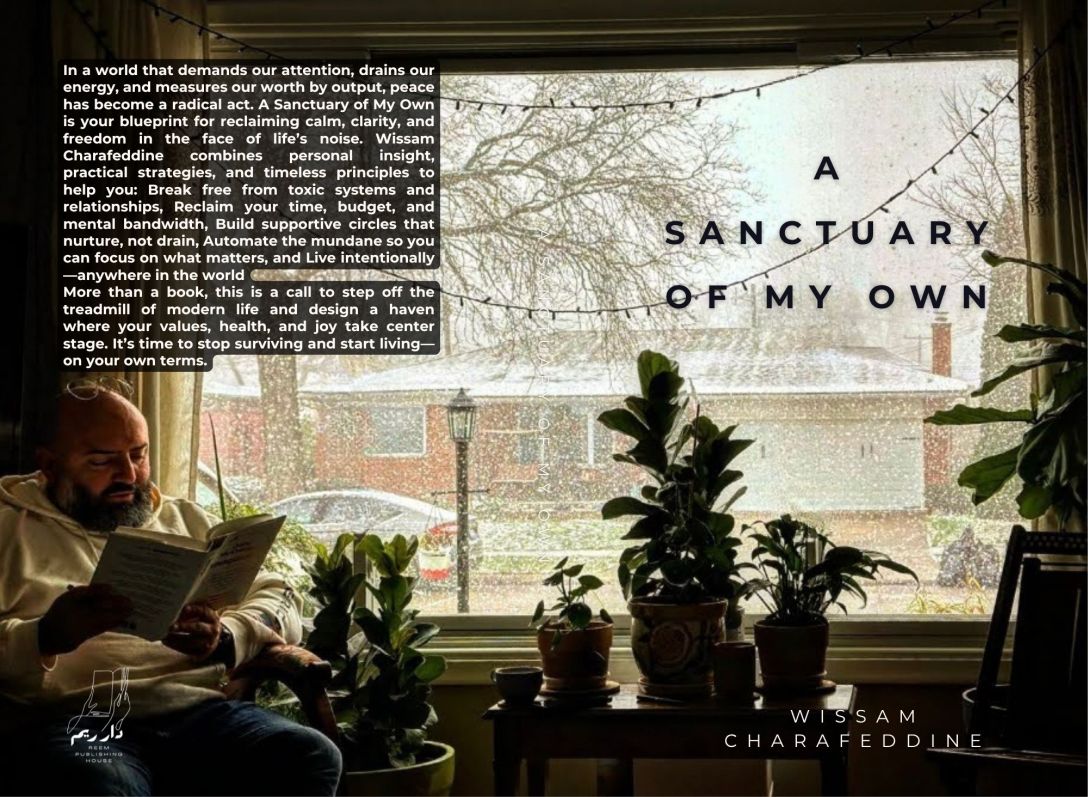
Arab American Author and Thinker Wissam Charafeddine Releases Groundbreaking New Book on Reclaiming Peace, Purpose, and Inner Calm in the Modern Age
FOR IMMEDIATE RELEASE
Contact: Wissam Charafeddine Dar Reem Publishing info@wissamc.com www.wissamc.com
Arab American Author and Thinker Wissam Charafeddine Releases Groundbreaking New Book on Reclaiming Peace, Purpose, and Inner Calm in the Modern Age
A Sanctuary of My Own: Building Calm, Clarity, and Control in the Age of Noise Is Now Available
Dearborn, Michigan — May 2026 — Dar Reem Publishing announces the release of A Sanctuary of My Own: Building Calm, Clarity, and Control in the Age of Noise by award-winning Arab American thinker, activist, author, and engineer Wissam Charafeddine. Published in the first edition of 2026, the book is a bold, deeply personal call to action for anyone who feels consumed by the relentless pace of modern life—and a practical roadmap for building a life defined by peace, intention, and meaning.
About the Book
In A Sanctuary of My Own, Charafeddine draws on decades of personal experience—including entrepreneurial ventures, financial setbacks, and profound philosophical reflection—to argue that the systems surrounding us were never designed for human flourishing. From punitive educational environments and aggressive economic structures to the dopamine-driven machinery of social media, the author makes an unflinching case that the modern world is engineered to burn us out.
But his message is not one of despair. It is one of reconstruction.
The book guides readers through six actionable steps to building their own sanctuary—including limiting social media, creating meaningful rituals, cultivating a circle of joy, and redesigning both the physical and digital environments around them. From there, Charafeddine introduces ten rules of tranquility, covering everything from financial freedom and caloric discipline to the irreplaceable value of integrity, deep friendship, and a worry-free mind.
In the book’s final section, Charafeddine shares seven life formulas—original frameworks that blend philosophy, economics, design thinking, and behavioral psychology. Among the most memorable is The Walid Question: a meditation on a real-life friend who, despite rejecting conventional ambition entirely, may have lived more joyfully than anyone around him. The question it poses is uncomfortable and essential: Are we working toward a life we already could have had?
Other formulas tackle the myth of passive income, the author’s personal interpretation of the global FIRE (Financial Independence, Retire Early) movement, the transformative power of systems in daily life, the psychology of design as a human necessity, and how to align one’s career and purpose with their unique zone of natural strength.
A Book Born from Real Life
A Sanctuary of My Own is intensely personal. Charafeddine wrote it, he says, at a time of high personal cost—emotionally and financially—as a gift to his children Mariam, Reem, and Ibrahim, and to every reader who deserves a life of dignity and peace.
“This book is the knowledge I paid for dearly through trial and error,” says Charafeddine. “I want my children—and every reader—to have it without the same price.”
Who This Book Is For
A Sanctuary of My Own speaks directly to:
- Professionals exhausted by hustle culture and constant connectivity
- Individuals seeking financial clarity and emotional simplicity
- Parents who want to build homes grounded in empathy rather than punishment
- Global citizens exploring intentional, location-independent lifestyles
- Anyone who feels lost in a world moving too fast
About the Author
Wissam Charafeddine is an Arab American thinker, activist, author, entrepreneur, educator, and engineer. He holds a Master’s Degree in Software Engineering from the University of Michigan Dearborn. He is a published poet with four collections to his name: The Opposite Swings, Climbing Leaves, Pains, and The Book of Paris. He is also the author of The Awaited Arab State, Universal Declaration of Human Values, and A Dialogue — A Universe from Void. Charafeddine is the founder of multiple nonprofit organizations and carries an extensive background in Islamic studies, Arabic history, and identity. He lives and works across multiple continents as a global citizen.
Publication Details
Title: A Sanctuary of My Own: Building Calm, Clarity, and Control in the Age of Noise Author: Wissam Charafeddine Publisher: Dar Reem Edition: First Edition Publication Year: 2026 ISBN: 9798297752566 Available at: www.wissamc.com and major booksellers
For media inquiries, speaking engagements, interview requests, or permissions, please contact: info@wissamc.com | www.wissamc.com
“In a world increasingly devoid of feelings, we must be the ones to remember what it means to truly live.” — Wissam Charafeddine, A Sanctuary of My Own
Podcast Episode: Article 11 – Security
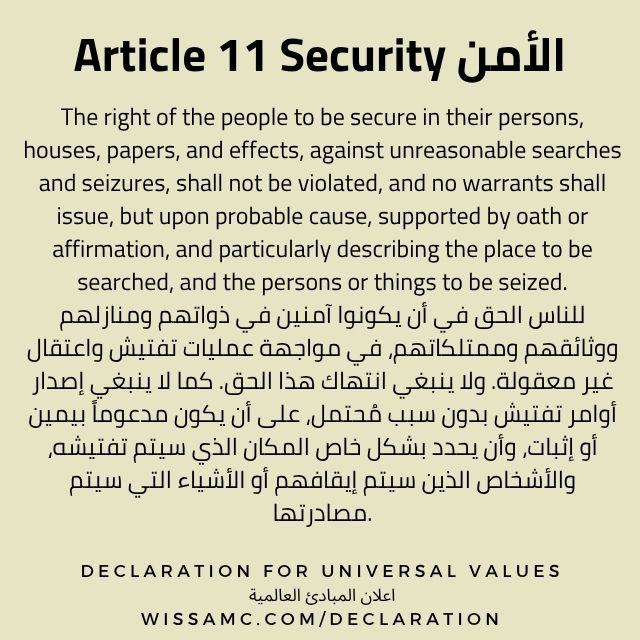
Pip: Wissam Charafeddine has been thinking about what it means to be free — specifically, the part where the government has to ask permission before going through your stuff.
Mara: Today we're looking at Article 11, which covers security, privacy, and the question of how far state power can reach before it crosses a line. Let's start with what that line actually looks like.
Article 11 — Privacy, Liberty, and State Power
Mara: The core tension here is whether privacy is a legal technicality or a condition of freedom itself — and the post opens by staking out a clear position on that question.
Pip: The framing sets it up directly: "A free society cannot exist where people live in fear that their homes, possessions, communications, or private lives may be invaded without just cause."
Mara: So the upshot is that privacy isn't a preference you trade away for convenience — it's the structural condition that makes other freedoms possible. Without it, the rest collapses.
Pip: The post traces this back historically. General warrants — vague, sweeping, requiring no specific justification — were a tool imperial governments used to intimidate populations and silence dissent. Article 11 is a direct answer to that history.
Mara: And the post extends that answer into the present. Phones, laptops, cloud accounts, browsing histories, biometric data — the argument is that a device search today is qualitatively different from searching a desk drawer. As the post puts it, "it is a search of a person's mind, relationships, beliefs, finances, movements, and memories."
Pip: Which makes the border-search question genuinely uncomfortable. Agencies like U.S. Customs and Border Protection have claimed authority to inspect devices at ports of entry — sometimes without a warrant, sometimes without individualized suspicion — under the doctrine that borders are a legal exception zone.
Mara: The post doesn't dismiss the security argument. It acknowledges that governments need tools to address trafficking, terrorism, and organized crime. But it holds the line: security cannot become an unlimited justification. Any border-search authority should be narrow, judicially overseen, and tied to genuine articulable suspicion.
Pip: There's a sentence near the end that does a lot of work: "The power to search must never become the power to dominate." That's the whole article in eleven words.
Mara: The post closes by arguing that true security and individual freedom aren't competing values — they reinforce each other, but only when the state remains bound by law, accountability, and respect for human dignity.
Pip: So the argument is that every erosion of privacy, even a small one at a border checkpoint, is a test of whether the exception eventually becomes the rule.
Mara: That question — where restraint ends and normalization begins — seems like exactly the kind of thing worth revisiting next time.

