
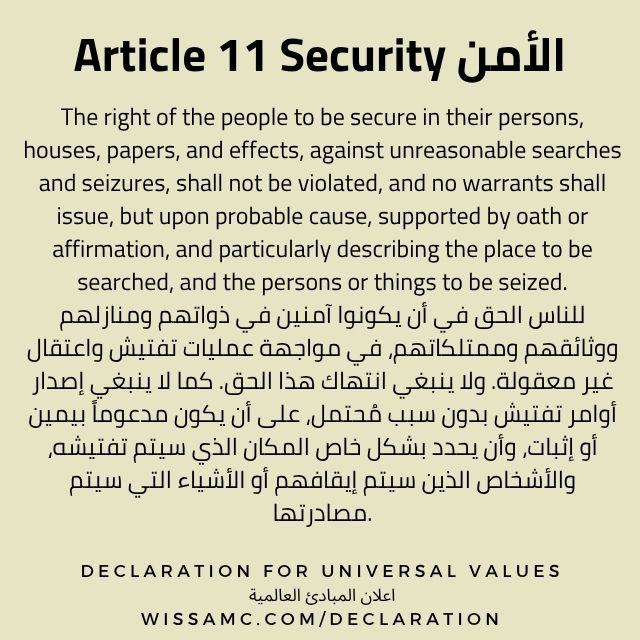
Pip: Wissam Charafeddine has been thinking about what it means to be free — specifically, the part where the government has to ask permission before going through your stuff.
Mara: Today we're looking at Article 11, which covers security, privacy, and the question of how far state power can reach before it crosses a line. Let's start with what that line actually looks like.
Article 11 — Privacy, Liberty, and State Power
Mara: The core tension here is whether privacy is a legal technicality or a condition of freedom itself — and the post opens by staking out a clear position on that question.
Pip: The framing sets it up directly: "A free society cannot exist where people live in fear that their homes, possessions, communications, or private lives may be invaded without just cause."
Mara: So the upshot is that privacy isn't a preference you trade away for convenience — it's the structural condition that makes other freedoms possible. Without it, the rest collapses.
Pip: The post traces this back historically. General warrants — vague, sweeping, requiring no specific justification — were a tool imperial governments used to intimidate populations and silence dissent. Article 11 is a direct answer to that history.
Mara: And the post extends that answer into the present. Phones, laptops, cloud accounts, browsing histories, biometric data — the argument is that a device search today is qualitatively different from searching a desk drawer. As the post puts it, "it is a search of a person's mind, relationships, beliefs, finances, movements, and memories."
Pip: Which makes the border-search question genuinely uncomfortable. Agencies like U.S. Customs and Border Protection have claimed authority to inspect devices at ports of entry — sometimes without a warrant, sometimes without individualized suspicion — under the doctrine that borders are a legal exception zone.
Mara: The post doesn't dismiss the security argument. It acknowledges that governments need tools to address trafficking, terrorism, and organized crime. But it holds the line: security cannot become an unlimited justification. Any border-search authority should be narrow, judicially overseen, and tied to genuine articulable suspicion.
Pip: There's a sentence near the end that does a lot of work: "The power to search must never become the power to dominate." That's the whole article in eleven words.
Mara: The post closes by arguing that true security and individual freedom aren't competing values — they reinforce each other, but only when the state remains bound by law, accountability, and respect for human dignity.
Pip: So the argument is that every erosion of privacy, even a small one at a border checkpoint, is a test of whether the exception eventually becomes the rule.
Mara: That question — where restraint ends and normalization begins — seems like exactly the kind of thing worth revisiting next time.

