
Author: W
Wissam, Wesley, or simply W, is an educator, writer, entrepreneur, engineer, activist, ex-Imam, humanist, liberal thinker with interest and mediocre attempt at many takes of life. A modern confused Renaissance man, who uses doubt as a path for emancipation and science as a road towards enlightenment.
“WHY I AM AGAINST ALL TAXES” … Public Wealth Economics by Wissam Charafeddine
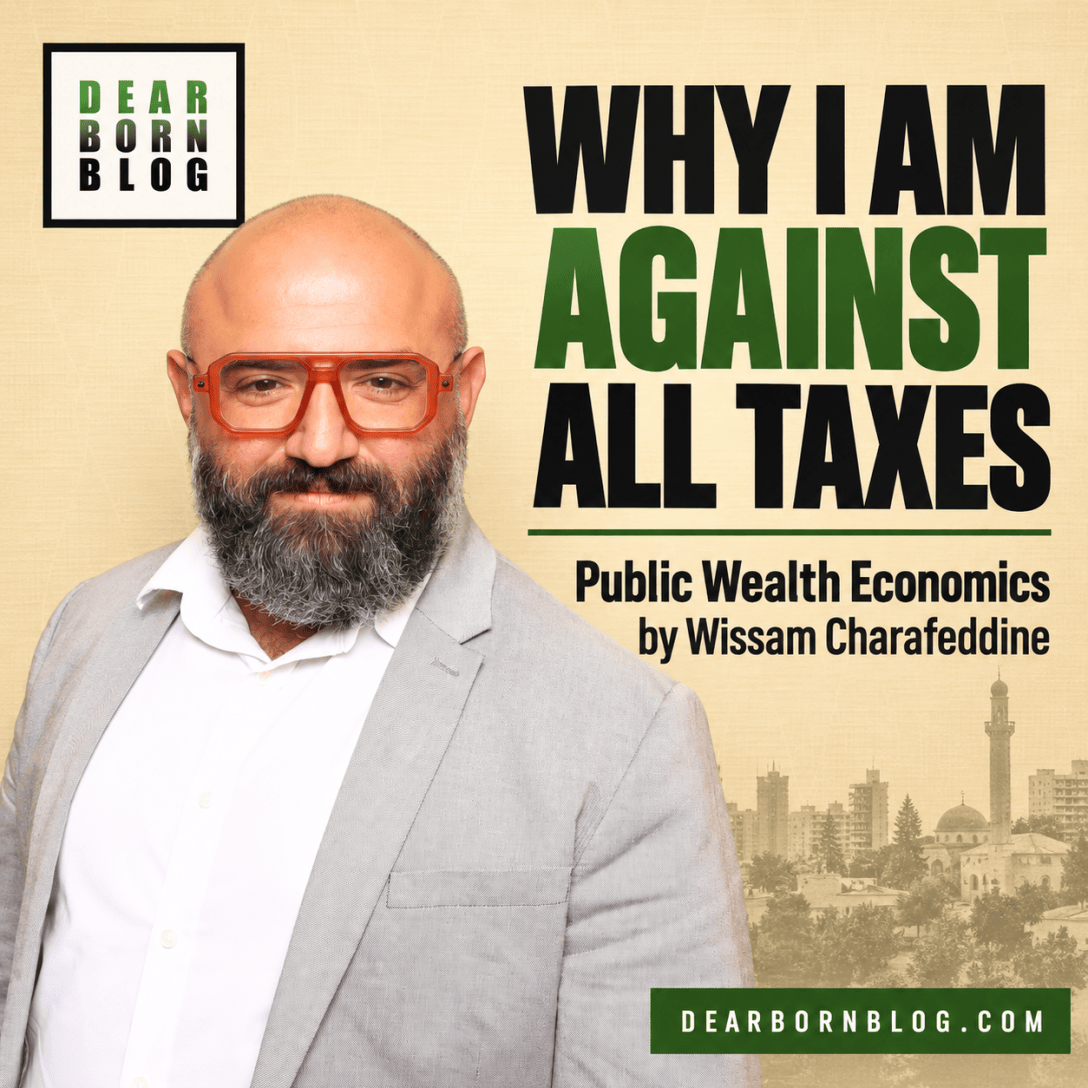
By Wissam Charafeddine | An Economic Vision for a Post-Tax Society
Introduction: Why Must the Government Be Poor When Its People Are Productive?
For centuries, governments have operated under an assumption so deeply embedded in political and economic thinking that few people seriously question it: to finance public services, the government must take a portion of what people earn, produce, purchase, or own.
We have built entire political systems around this assumption. Conservatives argue for lower taxes, progressives argue for more progressive taxes, and governments debate which activities, individuals, and corporations should bear the greatest burden.
Yet almost everyone accepts the underlying premise that taxation is the natural and unavoidable foundation of public finance.
I challenge that premise.
I believe that a government should aspire to become independently wealthy, not through extracting wealth from its citizens, but through creating, owning, managing, and investing productive assets.
My vision is of a government that earns its income rather than depending on the income of its people.
I oppose personal income taxes, corporate income taxes, and general sales taxes. I believe people should be entitled to retain the income they earn through their labor, creativity, entrepreneurship, and investment, and to spend that income without the government taking an additional percentage at the point of purchase.
This does not mean I oppose public education, healthcare, infrastructure, environmental protection, or the institutions necessary for a civilized society. On the contrary, I believe governments should have the financial strength to provide these services sustainably.
But the question is whether we can finance these obligations through an entirely different economic relationship between government and society.
Why should a government that controls valuable land, natural resources, infrastructure, commercial rights, public enterprises, and financial assets remain permanently dependent on taxing its citizens?
Why should the state not become an intelligent investor, responsible landlord, infrastructure operator, and successful entrepreneur?
And why should the prosperity of a government be measured by how much revenue it can collect from its citizens rather than how much independent wealth it can generate for them?
This is the foundation of what I call the Wealthy Government Model.
1. The Economic Foundations: This Is Not a New Idea
Although the modern tax system has made taxation appear indispensable, the idea of governments earning independent income has deep roots in classical economics.
In The Wealth of Nations (1776), Adam Smith distinguished between revenues generated from assets belonging to the sovereign or commonwealth and revenues collected from the people.
Smith recognized that governments could earn income from land and capital, including profits, interest, and rents. In Book V, Chapter II, he explicitly identified public property as a potential source of government revenue.
Smith also argued that certain public works could finance themselves. Roads, bridges, canals, harbors, and other facilities could charge users for the services they provided.
This is important because the intellectual father of modern capitalism did not assume that every government expense must be financed through broad taxation.
However, Smith was also skeptical of governments operating commercial enterprises efficiently and accepted taxation as necessary for certain public functions. His work therefore provides a historical foundation for alternative revenue sources, not an endorsement of abolishing all taxes.
Adam Smith Works
I would take the first part of Smith’s argument considerably further.
In an economy characterized by sophisticated financial markets, artificial intelligence, professional asset management, and globally connected investment opportunities, governments possess capabilities that eighteenth-century states could scarcely imagine.
The challenge is to design institutions capable of exercising those capabilities responsibly.
The question is no longer simply how much a government should tax.
It is how much productive wealth a government can responsibly own and manage.
2. Henry George: The Wealth of Land Belongs to the Community
One of the most important economists whose work supports an essential part of this philosophy is Henry George, the American political economist and author of Progress and Poverty (1879).
George challenged the justice and efficiency of taxing productive labor while allowing private landowners to capture increases in land value generated by the development of society.
Consider a simple example.
A private individual owns a vacant parcel of land worth $100,000. The government builds a public transportation station, improves nearby roads, expands public schools, and develops the surrounding neighborhood.
Ten years later, that parcel is worth $1 million.
The landowner may have done absolutely nothing to create the additional $900,000 in value.
The increase was produced largely by public investment, population growth, and collective economic activity.
Why should the entire increase belong exclusively to the landowner while the government must tax workers to pay for the infrastructure that helped create it?
George proposed capturing the economic rent of land for public purposes while reducing or eliminating taxes on labor and productive capital.
His famous proposal was to abolish other taxes and finance government through a single tax on land values.
henrygeorge.org
My proposal shares George’s distinction between wealth created through human effort and economic value derived from scarce natural opportunities.
But I would extend it through public ownership and leasing.
Rather than depending exclusively on a land-value tax, governments could retain ownership of strategically important public land and lease its use to private individuals and enterprises.
The private sector would develop, operate, and profit from productive activities. The public would receive a continuing income from the underlying land.
This is not the nationalization of every building or business.
It is the recognition that land is a productive public asset and that its economic value can support public institutions.
I would also preserve private property rights and seek voluntary acquisition, lawful public-land development, and carefully structured long-term leases rather than indiscriminate confiscation.
George’s distinction between land value and improvements offers a particularly useful principle: society should seek to capture economic rent without discouraging the people who build, innovate, and produce.
There is, however, an important terminological difference. George’s preferred instrument was legally a tax. My preference for contractual public-land leases is more consistent with my opposition to taxation, although both can capture similar forms of economic rent.
3. Government as an Entrepreneur, Not Merely a Regulator
A major weakness of conventional political thinking is the assumption that government must choose between two roles: regulating private economic activity or redistributing the proceeds of that activity through taxation.
I believe a third role deserves far greater attention.
Government can be an entrepreneur.
This does not mean that every government department should open a restaurant, manufacture automobiles, or compete indiscriminately with private businesses.
It means governments should identify commercially viable opportunities where public ownership can create long-term value, particularly in sectors involving natural monopolies, strategic infrastructure, or assets already owned by the public.
Consider several possibilities.
A municipal government may own parking facilities, commercial buildings, broadband infrastructure, energy generation systems, or strategically located real estate.
A state government may operate profitable transportation facilities, logistics infrastructure, investment funds, or publicly owned financial institutions.
A national government may retain equity interests in energy enterprises, telecommunications infrastructure, mineral development, or other strategic industries.
These activities can generate income through rents, service fees, dividends, royalties, and investment returns.
The government becomes an economic participant rather than merely an authority collecting revenue from others.
This approach requires an important institutional distinction: public ownership does not require political management of daily business operations.
Public enterprises should have professional boards, independently audited accounts, transparent performance standards, and clear commercial objectives.
Elected officials should determine public purposes and enforce accountability, not appoint political allies to run businesses for which they lack qualifications.
A government enterprise that survives only because taxpayers continually rescue it has failed the central objective of this model.
The goal is not simply to expand government ownership.
It is to create a portfolio of productive public assets that generates sustainable net income.
4. Sovereign Wealth Funds: Turning Public Assets into Permanent Income
One of the clearest demonstrations of public investment as a source of government revenue comes from sovereign wealth funds.
Instead of spending every dollar received from a natural resource, asset sale, or public enterprise, a government can invest part of that revenue in a diversified portfolio.
Over time, investment returns can help finance public services while preserving wealth for future generations.
Singapore offers an instructive example.
Its Net Investment Returns Contribution allows the government to spend up to 50% of expected long-term real investment returns on relevant reserves, subject to its established framework.
According to Singapore’s Ministry of Finance, investment returns from reserves finance approximately 20% of annual government spending, with an estimated contribution of S$28.48 billion for fiscal year 2026.
Ministry of Finance (MOF)
This does not mean Singapore has eliminated taxation. It has not.
But it demonstrates a fundamental principle: a government can finance a substantial portion of its public responsibilities from the returns on accumulated wealth rather than current taxation.
Another important feature of Singapore’s approach is its treatment of land proceeds.
Rather than routinely spending land-sale proceeds on annual operating expenses, the government incorporates them into reserves and uses investment returns to support spending.
This protects the public balance sheet from the temptation to sell valuable assets merely to finance today’s political priorities.
Ministry of Finance (MOF)
I believe every government should seriously examine the creation of a permanent public wealth fund.
Such a fund could receive income from public land leases, natural-resource royalties, profits from public enterprises, infrastructure concessions, and other non-tax revenues.
The principal would be invested, and a carefully determined portion of sustainable returns would finance public services.
The fund would belong to the public, not to the political party temporarily holding office.
Its assets should be protected from short-term political spending and managed with an intergenerational mandate.
A prosperous society should accumulate public wealth over generations, just as a financially responsible family accumulates assets rather than relying entirely on its next paycheck.
5. Alaska: When Public Wealth Pays the Citizens
An especially relevant example exists within the United States.
Alaska established its Permanent Fund in 1976 to preserve a portion of the state’s mineral wealth for future generations.
Rather than treating all oil revenue as money to be spent immediately, Alaska invested a portion of it in a permanent financial portfolio.
The fund now serves two purposes: supporting state government and providing direct dividends to eligible residents.
According to the Alaska Permanent Fund Corporation, earnings supporting the fund’s statutory draw account for more than 55% of the state’s unrestricted general fund revenue stream. Alaska’s 2026 Permanent Fund Dividend is $1,200 per eligible recipient, including an energy relief payment.
Alaska Permanent Fund Corporation
Alaska has not eliminated all taxation, and its reliance on oil presents long-term economic and environmental challenges.
Nevertheless, the model illustrates a profound possibility.
Instead of viewing citizens exclusively as taxpayers, governments can recognize them as beneficiaries of collectively owned wealth.
Imagine expanding this principle beyond oil.
What if a state’s public real estate, renewable energy assets, mineral royalties, infrastructure concessions, and investment holdings generated enough income to support substantial public services?
What if the financial relationship between government and citizens began with public dividends rather than tax bills?
I believe that possibility deserves serious economic exploration.
6. Natural Resources: Public Wealth Should Generate Public Income
Natural resources are among the most obvious sources of non-tax government revenue.
Oil, natural gas, minerals, forests, waterways, and other natural assets can generate substantial economic value.
However, public ownership of natural resources does not necessarily require the government to extract, process, or distribute them directly.
A government can retain ownership of resources while granting carefully regulated commercial extraction rights.
Private companies can provide capital, technology, and operational expertise. In return, they pay royalties, lease payments, or contractual shares of production to the public.
This arrangement can combine private-sector efficiency with public participation in the economic value of natural resources.
My preferred approach would include competitive bidding, transparent contracts, environmental safeguards, and long-term investment of resource proceeds.
It would also recognize that extracting a nonrenewable resource is not equivalent to creating recurring wealth.
If a government extracts a billion dollars of minerals and spends the entire proceeds on its annual budget, it has converted permanent natural wealth into temporary consumption.
That is not sustainable prosperity.
A responsible government should transform finite resources into durable financial assets and renewable sources of income.
For example, royalties from mineral extraction could help finance publicly owned solar farms, wind energy projects, battery storage facilities, and diversified investment funds.
In this way, one generation’s use of natural resources could establish income streams that benefit future generations.
Environmental protection must remain a binding constraint. A government that destroys forests, water systems, or public health to generate revenue is not becoming wealthier in any meaningful sense. It is exchanging one form of public wealth for another while potentially creating liabilities greater than its earnings.
The objective should be to maximize sustainable public value, not simply extraction revenue.
7. Government Services Should Generate Revenue Where Appropriate
Another component of my philosophy is straightforward: when government provides a service that creates identifiable private or commercial value, it should consider charging a reasonable fee.
This idea is consistent with the benefit principle of public finance, which links certain payments to the benefits received from public services.
It also has roots in Adam Smith’s discussion of self-financing infrastructure.
Not every public service should be charged to its users. But many services can support themselves, at least partially, through direct revenue.
Examples include commercial port operations, airport services, specialized business registrations, recreational facilities, public parking structures, and optional premium services.
A government that owns a modern convention center should seek to operate it with professional commercial discipline.
A publicly owned airport should explore appropriate revenue from commercial leases, parking, retail concessions, and airline services.
A public university may generate additional income from research commercialization, licensing, professional training, and partnerships with industry.
The objective is to reduce the dependence of these institutions on general public revenue without compromising their public missions.
There is an important distinction between a reasonable user fee and a disguised tax.
A fee should correspond to an identifiable service, access right, or commercial benefit. It should not be imposed arbitrarily merely because the government needs money.
I would also reject the idea that every government function should operate on a fee-for-service basis.
Access to justice, emergency response, basic public education, and essential protections cannot depend entirely on an individual’s ability to pay.
The government should finance those universal obligations through the collective income generated by its assets and investments.
The purpose of a wealthy government is not to charge citizens for everything. It is to possess enough independent wealth that essential public services do not require charges at the point of need.
8. Mariana Mazzucato and the Entrepreneurial State
A contemporary economist whose work strongly complements this vision is Mariana Mazzucato, author of The Entrepreneurial State.
Mazzucato challenges the conventional division between an innovative private sector and a government that merely regulates or corrects market failures.
She argues that governments have frequently played important roles in financing and developing transformative technologies.
Her work highlights how public investment has contributed to technological advances in fields such as computing, biotechnology, and renewable energy.
But an especially important aspect of her argument concerns the distribution of rewards.
When governments finance risky research and development, the public often assumes substantial risks while private enterprises capture much of the financial upside.
Mazzucato and Henry Lishi Li discuss mechanisms through which the public sector can retain a share of the returns generated by publicly supported innovation, including equity ownership, licensing, and profit-sharing arrangements.
Politics, Policy, and Public Options
+1
I would apply this principle to the broader question of government finance.
If public money helps develop a commercially successful technology, why should the government’s only possible financial return be future tax revenue?
Why not retain a minority equity interest?
Why not negotiate royalties from commercially licensed discoveries?
Why not create investment vehicles that allow the public to participate in the financial success of enterprises built with substantial public support?
Imagine a publicly funded research institution developing a breakthrough medical technology.
A private company licenses the discovery, invests in commercialization, and generates substantial profits.
Under an appropriately structured agreement, the public institution could receive continuing royalties that finance additional research.
The public would benefit from both the innovation itself and the financial returns it generates.
This is a model of public entrepreneurship that does not require government to replace private enterprise.
It creates a partnership in which risks and rewards are more deliberately shared.
Mazzucato does not advocate abolishing income and sales taxes. That conclusion is my own. But her economic framework provides strong support for the idea that governments can participate directly in wealth creation and capture financial returns beyond conventional taxation.
9. Public Banking and the Productive Use of Capital
Government-owned financial institutions offer another potential source of revenue.
A public bank can finance infrastructure, support productive investment, and retain earnings for public purposes.
Such institutions may provide financing for municipal utilities, affordable housing development, small-business lending, renewable energy infrastructure, and other economically productive activities.
However, public banking should not be confused with the ability to create unlimited government revenue.
Banks must maintain capital, manage credit risk, comply with applicable regulations, and absorb losses when borrowers fail to repay loans.
A public bank that lends recklessly can become an expensive liability rather than a valuable asset.
My proposal would therefore emphasize independent management, prudent underwriting, transparent financial reporting, and strict limits on politically directed lending.
The purpose of a public bank should be to finance economically sound projects that advance public objectives while preserving financial sustainability.
Public banking could complement a broader system of sovereign wealth funds, publicly owned infrastructure, and revenue-producing assets.
10. The Economic Case Against Taxing Income and Consumption
My opposition to income and sales taxes rests on several arguments.
First, income taxation reduces the financial reward individuals retain from productive economic activity.
When people work, develop businesses, invest capital, or create valuable products, a portion of their earnings is transferred to the state.
Economists disagree about the magnitude of the resulting effects on labor supply, savings, investment, and entrepreneurship. Those effects depend on tax rates, design, and economic conditions.
Nevertheless, the basic principle is well established: taxes can change incentives.
Second, sales taxes increase the price paid by consumers for taxable goods and services.
Broad consumption taxes can also impose proportionally heavier burdens on lower-income households when measured against current income, although exemptions, rebates, and the treatment of lifetime consumption complicate the comparison.
Third, taxation requires substantial administrative systems.
Individuals and businesses must maintain records, calculate obligations, file returns, and sometimes engage professionals to ensure compliance.
Governments must administer tax codes, conduct audits, resolve disputes, and enforce collection.
Some of these administrative costs would disappear if income and general sales taxes were eliminated.
Others would be replaced by the costs of managing public assets and collecting alternative revenues.
My argument is not that all taxation necessarily destroys economic productivity. The evidence does not support such an absolute claim.
Rather, I question why taxes on productive income and consumption should remain the default foundation of government finance when alternative sources of public revenue exist.
I would prefer a system that places greater emphasis on returns from public assets, economic rents, voluntary commercial transactions, and investment income.
A critical distinction must be maintained: royalties, lease payments, and user fees are not automatically free of economic burdens. Businesses may pass some costs to consumers, and public monopolies can impose excessive prices.
The economic advantages of alternative revenue systems must therefore be demonstrated rather than assumed.
11. The Mathematics of a Wealthy Government
A credible proposal must go beyond philosophy and confront financial reality.
Suppose a government requires $10 billion annually to finance its public obligations.
If it intends to finance the entire budget through investment returns, and can sustainably spend 4% of the value of its investment portfolio each year, it would need approximately $250 billion in invested assets.
Illustrative public investment fund
Annual spending requirement
$10 billion
Sustainable annual draw assumption
4.0%
Required invested assets
$250 billion
Illustrative arithmetic, not a guaranteed investment return. Actual sustainable withdrawals depend on inflation, market risk, fees, and portfolio composition.
This calculation illustrates both the potential and the challenge of replacing taxation with investment income.
A government that already owns substantial valuable assets may have a meaningful foundation for such a transition.
A government with limited assets, significant debts, and large spending obligations may need decades to accumulate sufficient public wealth.
The transition must therefore be gradual, evidence-based, and fiscally responsible.
There is also a distinction between gross government assets and net public wealth.
A government may own valuable infrastructure while carrying substantial debt or deferred maintenance obligations.
Selling a public asset to pay down debt does not automatically increase net wealth. Similarly, borrowing money to purchase financial investments does not guarantee that the government will earn more than its financing costs.
The Wealthy Government Model must therefore measure net assets, net operating income, risk-adjusted returns, and long-term fiscal sustainability.
12. A Practical Roadmap Toward a Post-Tax Economy
I envision a transition built around six major reforms.
First, create a comprehensive public asset inventory. Governments should publish an accurate accounting of publicly owned land, buildings, mineral rights, infrastructure, commercial holdings, and financial investments. Assets that are currently underused should be evaluated for productive development without sacrificing their public or environmental value.
Second, establish independent public wealth authorities. These institutions would manage commercial assets professionally, under transparent rules and democratic oversight. Their objective would be sustainable long-term returns, not short-term political advantage.
Third, expand revenue-producing public infrastructure. Governments should evaluate commercially viable investments in renewable energy, telecommunications infrastructure, ports, logistics facilities, and other sectors where public ownership offers identifiable economic advantages.
Fourth, develop public-land leasing and resource-income strategies. Public land should be treated as a long-term asset. When appropriate, leasing should be considered instead of permanent sale. Natural-resource contracts should provide fair public compensation while protecting the environment and local communities.
Fifth, accumulate permanent investment funds. A substantial share of non-tax revenue should be invested rather than immediately consumed. Withdrawals should follow rules designed to preserve purchasing power and protect future generations.
Sixth, reduce income and sales taxes as replacement revenues become reliable. Tax reductions should be tied to independently verified, recurring net revenue rather than optimistic projections or temporary asset sales.
This last point is essential.
I do not propose eliminating income and sales taxes overnight and hoping that public enterprises somehow replace them.
I propose constructing an alternative revenue system first, measuring its performance, and reducing taxes as the government acquires the financial capacity to operate without them.
The long-term destination would be the elimination of personal income taxes, corporate income taxes, and general sales taxes.
The timetable would depend on actual economic results.
13. The Strongest Objections—and Why They Matter
Any serious economic philosophy must confront the strongest arguments against it.
The first objection is that governments are not always efficient business operators.
Political interference, weak incentives, corruption, and poor management can undermine publicly owned enterprises.
I accept this risk.
That is why public ownership must be separated from day-to-day political control, with independent audits, transparent procurement, professional management, and measurable performance requirements.
The second objection is that public investments can lose money.
That is also true.
Sovereign wealth funds experience market downturns, infrastructure projects can fail, and natural-resource prices fluctuate.
A government cannot promise a guaranteed return simply because it owns assets.
The appropriate response is diversification, conservative financial planning, prudent reserves, and disciplined investment governance.
The third objection is that user fees may disproportionately affect poorer citizens.
This concern is especially important.
A wealthy government should not replace progressive taxation with an extensive system of regressive charges.
Essential services should remain universally accessible, while commercial services and optional uses of public assets can generate revenue.
The fourth objection concerns competition.
A government-owned enterprise may enjoy advantages unavailable to private competitors, including preferential financing, regulatory influence, or access to public assets.
Without safeguards, this could undermine entrepreneurship rather than support it.
Public enterprises should therefore operate under transparent competition rules, and regulators should be institutionally independent of the enterprises they oversee.
The fifth objection is perhaps the most significant: the available non-tax revenue may simply be insufficient to finance a modern government.
This is a serious empirical question, not something that can be answered through ideology.
Countries differ enormously in their natural resources, accumulated public wealth, population, economic structures, and spending obligations.
Some governments may be able to replace substantial portions of taxation through asset income. Others may face a much larger gap.
A credible post-tax model must establish how that gap would be closed without unsustainable borrowing, inflationary financing, excessive service charges, or the depletion of public assets.
Finally, public ownership of wealth creates a political question: who controls it?
A wealthy government that lacks democratic accountability could become economically powerful while remaining unresponsive to its citizens.
The objective must never be to make the state rich at the expense of the public.
The government is a trustee, not the ultimate beneficiary.
Public wealth must remain subject to constitutional protections, transparent accounting, democratic oversight, and enforceable safeguards against corruption.
14. A Different Understanding of Government Prosperity
The conventional model of public finance begins with the economic activity of citizens and asks how much of its proceeds the government should collect.
My model begins with the assets, opportunities, and productive capacities of the public sector and asks how much independent income they can generate.
This difference is more than technical.
It changes the relationship between the state and society.
Under the conventional system, the government’s fiscal health depends heavily on its ability to collect revenue from individuals and businesses.
Under the Wealthy Government Model, the government would increasingly depend on the performance of assets held in trust for the public.
The incentive would be to accumulate productive wealth, invest wisely, maintain infrastructure, develop valuable public resources, and preserve capital across generations.
I recognize that a wealthy public sector does not automatically produce a wealthy population.
A country can have enormous state-owned assets while ordinary citizens experience poverty, inequality, or political exclusion.
That is why the model must be judged not only by the size of the government’s balance sheet but by its ability to deliver public services, expand economic opportunity, preserve individual freedoms, and improve living standards.
Public prosperity and private prosperity should reinforce one another.
They should not compete.
Conclusion: From a Tax-Dependent State to a Wealth-Creating State
I believe the future of public finance deserves a far more ambitious imagination than the endless debate over whether income taxes should rise or fall by a few percentage points.
We should be asking a more fundamental question.
Can we build governments that generate enough independent wealth to finance their responsibilities without taxing what people earn or purchase?
I believe this should become a serious long-term economic objective.
The intellectual foundations already exist in the work of Adam Smith, Henry George, and contemporary economists such as Mariana Mazzucato.
Practical elements can be observed in the public investment frameworks of Singapore and Alaska, even though neither has eliminated taxation.
What remains is to bring these ideas together into a coherent system of public asset ownership, professional enterprise management, sustainable investment, and responsible fiscal transition.
My philosophy is neither a rejection of government nor an unconditional endorsement of government ownership.
It is a demand that government become more economically capable, financially disciplined, and creative in generating revenue.
I want a government strong enough to finance excellent schools, reliable infrastructure, essential public services, and environmental stewardship.
But I do not believe that strength must forever depend on taking a percentage of every paycheck or every purchase.
A government should be capable of creating wealth, not merely redistributing it.
It should preserve productive assets for future generations rather than liquidating them to cover today’s expenses.
It should earn returns from the resources it manages and the value it helps create.
And it should measure its financial success by how much prosperity it delivers to the public, not simply by how much money it collects from the public.
My ultimate economic vision is simple: a wealthy government, a prosperous people, and a society in which public services are financed increasingly by shared wealth rather than taxes on individual productivity and consumption.
The goal is not merely lower taxes.
It is to make taxation on earnings and everyday purchases increasingly unnecessary.
References and further reading
The following sources distinguish economists who provide theoretical foundations for parts of this proposal from governments that demonstrate particular financing mechanisms. None of the cited economists should be understood as endorsing every element of the Wealthy Government Model.
1. Smith, Adam (1776). An Inquiry into the Nature and Causes of the Wealth of Nations, Book V, Chapters I–II. Particularly relevant are the discussions of publicly owned revenue sources and user-financed infrastructure. Read the relevant text.
2. George, Henry (1879). Progress and Poverty. George’s proposal to capture land rents for public revenue provides the closest historical precedent for replacing conventional taxation with revenue derived from economic rent. Read Chapter 32: The Remedy.
3. Ricardo, David (1817). On the Principles of Political Economy and Taxation. Ricardo’s theory of differential rent provides an important foundation for understanding land rents and the distribution of economic surplus. George discusses Ricardo’s analysis in Progress and Poverty.
henrygeorge.org
4. Mazzucato, Mariana (2013; updated edition 2024). The Entrepreneurial State: Debunking Public vs. Private Sector Myths. Explores government as a creator of economic value and an investor in innovation. Book information.
5. Mazzucato, Mariana, and Henry Lishi Li (2021). “The Entrepreneurial State and Public Options: Socializing Risks and Rewards,” in Politics, Policy, and Public Options, Cambridge University Press. Especially relevant to public equity, royalties, and mechanisms for obtaining financial returns on public investments. Read the academic chapter.
6. Singapore Ministry of Finance (2025). “Net Investment Returns Contribution.” Explains the constitutional framework permitting a portion of investment returns to support annual government spending. Official government source.
7. Singapore Ministry of Finance. “What Are the Reserves Used For?” Explains how public investment returns finance spending and why proceeds from land transactions are treated differently from ordinary budget revenue. Official government source.
8. Alaska Permanent Fund Corporation. “Fund Structure.” Describes the constitutionally protected principal, earnings reserve, and the fund’s role in financing government operations. Official fund documentation.
9. Alaska Department of Revenue (2026). “Permanent Fund Dividend.” Provides information on the distribution of investment earnings to eligible Alaska residents. Official dividend program.
Isle du Cite – Paris – October 2 2026
An Afternoon Nap – Pont du Saint Louis – Paris – Friday October 2, 2026
Parvis du Sacre Coeur – Montmartre – Paris – Saturday October 3, 2026
Place du Tertre – Montmartre – Paris – October 3, 2026
Death of a Poet


Some things do not leave when they are gone.
They remain in a cup on the table, an empty side of a bed, a road bending out of sight, a dress that still carries a memory, photographs lowered into boxes.
Death of a Poet follows a poet through love, place, memory, silence, and finally loss.
Written across several years—and culminating in an intensely personal sequence composed during the summer of 2026—these poems move from beaches and cities to bedrooms, gardens, abandoned rooms, rain, rivers, and the ordinary objects that become unbearable when someone disappears from a life.
The collection begins with a man looking outward at the world and gradually turns inward, toward the strange archaeology of intimacy: what remains after love changes, what memory refuses to surrender, and what part of ourselves must sometimes disappear before another can emerge.
There are no easy conclusions here.
Only traces.
A sunflower.
A coffee cup.
A photograph in a box.
A bending road.
And somewhere among them—
an old poet who is no longer there.

