
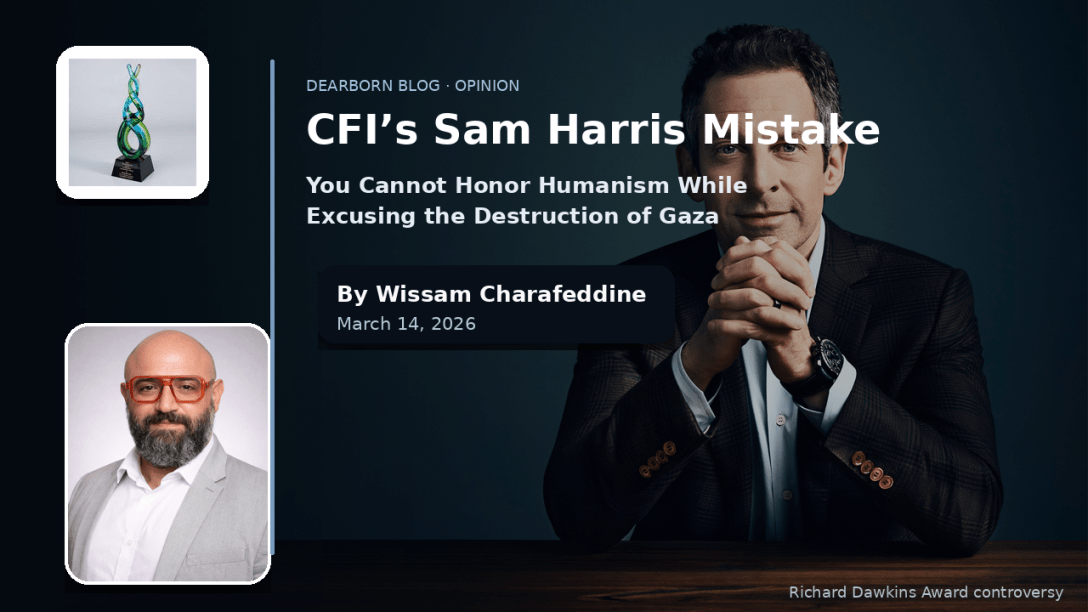
The Center for Inquiry says the Richard Dawkins Award honors a person who publicly represents secularism and rationalism, and CFI says its mission is to advance reason, science, freedom of inquiry, and humanist values. Sam Harris may fit the secular-celebrity part of that profile, but I do not believe he fits the humanist part. With Richard Dawkins set to present him the 2026 award in an online ceremony on April 18, this is exactly the moment to ask whether intellectual sharpness without moral clarity is really what CFI wants to celebrate. (Center for Inquiry)
My objection is not that Harris criticized Hamas. Anyone with a functioning conscience condemns the October 7 atrocities. My objection is that Harris has repeatedly framed Israel’s assault on Gaza not as a political catastrophe with history, occupation, dispossession, and civilian annihilation, but as a civilizational morality play. In January 2024 he described the issue as a “clash of cultures” in which “real civilization” exists “only on one side,” casting the fight as one between jihadists and “ordinary human beings.” That framing does not illuminate reality; it bulldozes it. Palestinians disappear as a people with rights and history and reappear only as background scenery in someone else’s war on barbarism. (Sam Harris)
Worse, Harris did not merely defend Israel’s right to respond. He dismissed the very charge of genocide as “patently false,” mocked it as the “most inept genocide in history,” and called it a “new blood libel.” That is not sober skepticism. That is rhetorical contempt aimed at a grave legal and moral question. Amnesty International concluded in December 2024 that Israel is committing genocide in Gaza, and Human Rights Watch found extermination and acts of genocide, with conduct and official statements that may amount to genocidal intent. Human Rights Watch also noted that these policies continued after multiple International Court of Justice provisional measures in 2024 ordering protections for Palestinians in Gaza and humanitarian relief, including water, food, electricity, and fuel. A serious thinker did not have to prejudge every legal question to remain decent here. He only had to refrain from sneering at the possibility while Gaza was being destroyed in real time. (Sam Harris)
Francesca Albanese, the UN Special Rapporteur on the occupied Palestinian territory, has been one of the clearest international voices naming what much of the West refuses to face: in March 2024 she said the “threshold indicating Israel’s commission of genocide had been met,” and by July 2025 she described Gaza as “one of the cruellest genocides in modern history.” In the official language I could verify, she and fellow UN experts framed Gaza as an “urgent moral crossroads” whose destruction carries “irreversible consequences for our shared humanity and multilateral order” — which is really another way of describing what many people mean by the fall of Western civilization: a moral collapse dressed up as policy. A civilization that excuses genocide in Gaza, tolerates the bombardment and mass displacement of Lebanon, and joins or blesses illegal attacks on Iran while claiming to defend “order” is not defending law at all; Today’s Western civilization is a performing cruel barbaric empire in a suit and tie. UN experts this month called the attack on Iran “entirely illegal under international law,” warned that the forced displacement in Lebanon “would constitute yet another war crime,” and said this path is pushing the world toward a “moral and legal abyss.” Add to that the fact that Iran denies seeking nuclear weapons, the U.S. intelligence community said in 2025 that Iran was not building one, and Tehran continues to invoke its NPT right to civilian enrichment, while the IAEA has reiterated that armed attacks on nuclear facilities devoted to peaceful purposes violate the UN Charter and that such facilities “must never be attacked.” That is the real indictment: what is collapsing before our eyes is not merely the credibility of Western governments, but the pretense that Western civilization still stands for universal law, equal human dignity, or anything beyond selective morality backed by bombs.
That is why I say Harris is not worthy of this award. I am not arguing that he signed an order or pulled a trigger. I am saying that his public language has functioned as moral cover: it narrows sympathy, launders asymmetry, and trains his audience to treat Palestinian suffering as tragic but secondary—an unfortunate price of civilization defending itself. When a public intellectual responds to mass atrocity by ridiculing genocide warnings rather than reckoning with them, he is not modeling rational courage. He is modeling dogmatic ideological loyalty, and that is the furthest from reason. (Sam Harris)
The problem is broader than Gaza. Harris has spent years insisting that his criticism is only about ideas, not people, yet his own language routinely slips from critique of extremists into sweeping claims about Islam itself. He has written that “Islam is the Mother lode of bad ideas,” described a long struggle between “Western civilization and Islam,” and said “we are perpetually at war” with jihadists while presenting confusion about this as a civilizational failure. In the same period, he claimed the term “Islamophobia” was invented by “Iranian theocrats” to shut down criticism of Islam. That claim is historically shaky at best: the Oxford English Dictionary traces the word to the 1920s in English, and scholarship cited in search results traces French usage to 1910, long before the Iranian Revolution. (Sam Harris)
And here is the deeper problem: Islam is not just a detachable list of propositions floating in a vacuum. Even by Western standards, Britannica describes Islam as a major world religion, and the “Islamic world” as a complex of societies and cultures in which Muslims and their faith have been socially dominant. One of 4 people on Earth are Muslim, and Islam is as diverse as anthropology itself. The United Nations marks an International Day to Combat Islamophobia because anti-Muslim hatred is not imaginary word-policing; it is a real pattern of hostility directed at people and communities. It is stabbed children, and run over women with cars. So yes, ideas must be criticized, and Islam shall be criticized. But when a writer persistently speaks of Islam in civilizational terms and treats anti-Muslim animus as mostly a semantic trick, he helps create the very climate in which human beings are reduced to abstractions. It is the old white supremacist habit of dehumanization, just appearing now with a podcast microphone and a neuroscience résumé. (Encyclopedia Britannica)
The Richard Dawkins Award is supposed to honor secularism, rationalism, and scientific truth. Fine. But secularism without equal human dignity becomes sectarianism for people who pride themselves on not having a sect. Reason that can dissect superstition but cannot recognize mass dehumanization is not moral courage; it is a very polished blind spot. Sam Harris has every right to speak. CFI has every right to honor whom it wishes. But I also have every right to say that giving him this award—during the genocide in Gaza, after his repeated dismissal of genocide claims, and after years of flattening Islam into a near-total explanation of Muslim violence—betrays the humanist values CFI says it stands for. (Center for Inquiry)
If the Richard Dawkins Award is to mean anything, it should go to people who defend reason without abandoning humanity. Sam Harris, in my view, has failed that test. Not because he criticizes religion, but because he does so in a way that too often rationalizes hierarchy, excuses state violence, and treats one population’s fear as tragedy and another population’s destruction as argument. That is more tribalism and less enlightenment (Sam Harris). I would nominate Elen Pappe, Norman Finklestein, or Francesca Albanese herself for defending reason and humanity in the face of the fascist leaning current American dogmatic evangelical zionist administration and Israeli fanatic right government, that is exerting direct pronounced efforts to prohibit even proper language of reason from being used, social media from acting free, and commits a massacre of over 300 journalists in one year to burry reason.
Wissam Charafeddine
CFI Michigan Award Winner of Promotion and Defense of Science, Reason, Free Inquiry & Humanist Values







 Wissam Charafeddine