Trump’s War and Gendered Colonialism

Trump’s attack on Iran has been wrapped in shifting justifications: nuclear danger, missile threats, freedom for the Iranian people, and now threats against civilian infrastructure. But behind the changing script sits an older Western habit: gendered Orientalism, the idea that Muslim societies are uniquely barbaric and their women uniquely in need of rescue. That framework does not liberate women. It launders empire.

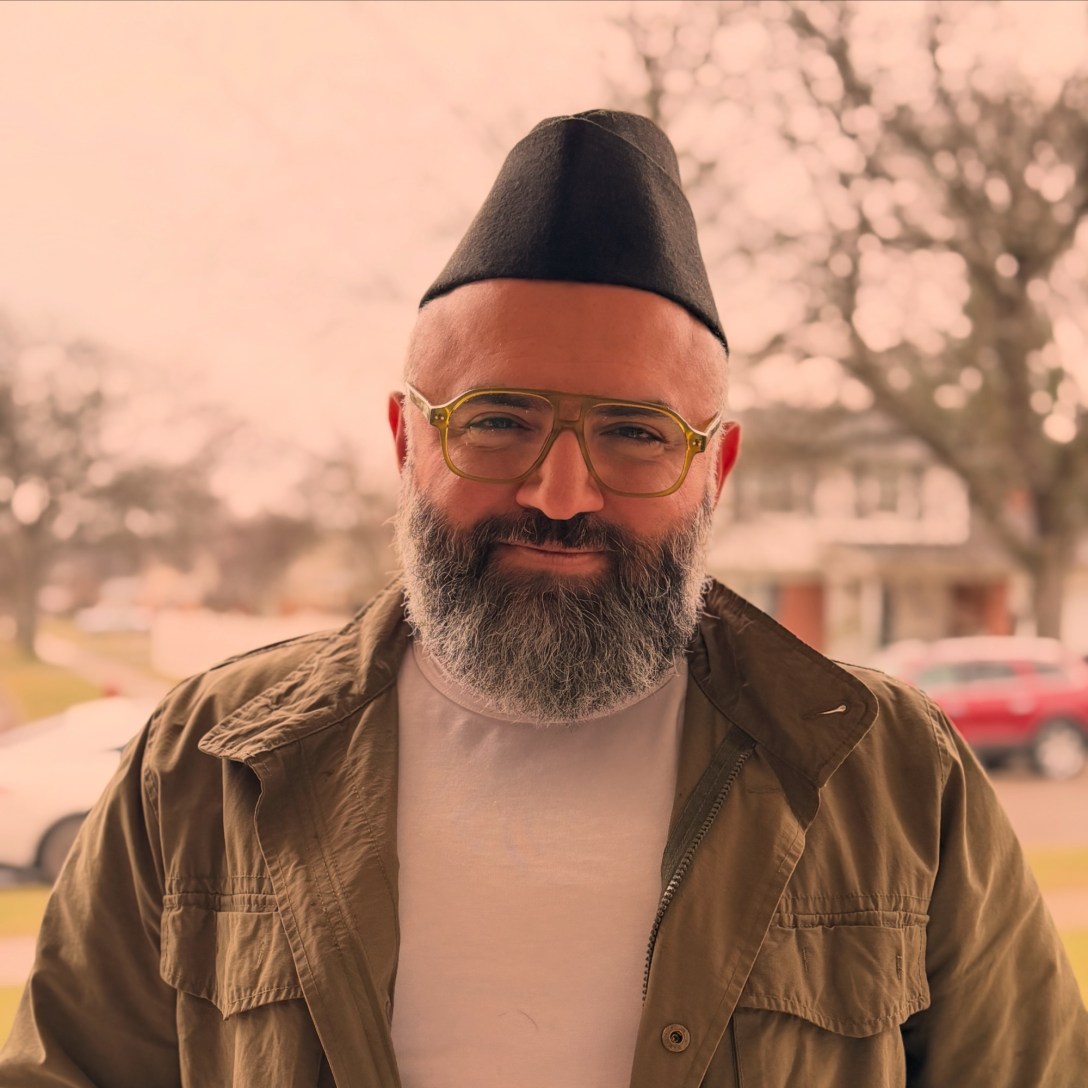
By Wissam Charafeddine

Donald Trump’s attack on Iran is not just a military escalation. It is also a familiar political performance. The justifications keep shifting, but the moral packaging stays recognizable: Iran is cast not simply as a state adversary, but as a civilizational villain, a place of darkness, repression, and backwardness from which people—especially women—must be saved. Reuters reported on March 20, 2026 that Trump’s stated reasons, goals, and timeline for the war had repeatedly shifted. Earlier public explanations emphasized nuclear and ballistic missile threats, while other messages invoked broader ā€œfreedomā€ language toward the Iranian people. 

That is where gendered Orientalism enters the picture.

The cleanest term for this framework is gendered Orientalism: the old habit of portraying the Middle East as uniquely misogynistic, uniquely uncivilized, and uniquely in need of Western force or supervision. Scholars have long shown that gender is not a side issue in Orientalism; it is one of its core engines. Women become symbols of a society’s supposed backwardness, while men become symbols of danger, patriarchy, and moral inferiority. 

So when a U.S. administration or its surrounding media ecosystem presents Iran not just as a geopolitical rival but as a place whose people are waiting for salvation, that is not neutral language. It is part of an old imperial script. In Trump’s February 28 statement after the attacks, he told ā€œthe great proud people of Iranā€ that ā€œthe hour of your freedom is at hand.ā€ The White House then amplified that message on March 1 with a post celebrating ā€œOperation Epic Furyā€ and claiming that ā€œ2026 will be the year the Iranian people finally achieve freedom.ā€ 

Notice the trick. Bomb first. Speak of freedom second. Call it liberation third. Same movie, new poster.

To be precise, Trump’s public rationale has not been consistently framed around women’s rights. Reuters noted that his administration’s explanations have moved among claims about nuclear weapons, ballistic missiles, retaliation, and broader strategic goals. AP also reported on March 21 and March 22 that Trump threatened to ā€œobliterateā€ Iranian power plants if Tehran did not fully open the Strait of Hormuz, widening the war’s logic yet again. 

But that inconsistency is exactly the point. The official justifications wobble. The deeper civilizational narrative does not. Even when women’s rights are not the formal legal argument, they often function as the moral soundtrack in the background: Iran is bad not merely because it is an adversary, but because it is imagined as a place where women are crushed, religion rules, and brown men embody oppression. That story helps sell punishment to Western audiences. It turns war into virtue.

Scholars have names for this beyond gendered Orientalism. Colonial feminism describes the use of women’s rights language to justify domination. Femonationalism describes the selective use of feminist rhetoric to support nationalist, anti-Muslim, or exclusionary politics. The point is not that women’s suffering is unreal. The point is that powerful states suddenly discover intense concern for Muslim women when that concern can be weaponized against Muslim societies. 

And Iran is one of the clearest examples of how that mechanism works.

Nobody serious should deny that Iranian women have faced state repression. They have. The struggles of Iranian women are real, brave, and historic. Human Rights Watch wrote on March 6, 2026 that attacks on women’s rights are deeply tied to authoritarian politics, in Iran and elsewhere. Iranian women have resisted compulsory dress codes, state violence, and political repression for decades, and recent scholarship continues to document the depth and persistence of that struggle. 

But here is the line that empire always tries to blur: Iranian women’s struggle belongs to Iranian women. It does not belong to Trump.

Trump is not attacking Iran because he woke up in a feminist mood. This is the same political universe in which women’s rights are rolled back at home, reproductive autonomy is attacked, and ā€œgender ideologyā€ is treated as a political enemy. Human Rights Watch explicitly tied Trump’s domestic posture to broader assaults on women’s rights and democracy. 

So let’s not play dumb. When people around Trump world wrap war in civilizational language about freedom, repression, or the moral sickness of Iran, they are not practicing solidarity. They are using a selective human-rights vocabulary to dress up force. That is not feminism. It is empire with a better publicist.

A rule worth remembering:

When bombs are sold as a shortcut to women’s freedom, somebody is lying.

We have seen this before. Legal and scholarly critiques of the post-9/11 era have shown how women’s rights were folded into the ā€œwar on terrorā€ as a legitimating story. The invasion of Afghanistan was famously narrated as a rescue mission for women, even as war itself deepened insecurity and foreign power rearranged women’s lives without their consent. Scholarship in international law and Middle East studies continues to describe this as the co-optation of women’s rights into military projects. 

Iran now risks being pushed through a similar template.

The image is simple and seductive to Western audiences: oppressive regime, oppressed women, dangerous men, outside savior. It is tidy, flattering, and false. False because Iranian society is not reducible to a cartoon. False because Iranian women are political subjects, not props. False because outside military force does not arrive in the region with clean hands. And false because the same powers claiming moral concern routinely support authoritarian allies when convenient.

That is why white non-Arabs, especially white liberals, should be careful here.

Be careful when ā€œconcern for womenā€ appears only in the run-up to sanctions, bombing, destabilization, or regime-change fantasies. Be careful when media and politicians suddenly discover moral clarity about Muslim women abroad while shrugging at women’s suffering at home. Be careful when Iranian women are treated as evidence for war rather than as agents with their own politics. Be careful when Iranian men are flattened into a stereotype of fanatic patriarchy while Western violence is treated as regrettable but rational.

That flattening is not an accident. It is how gendered Orientalism works. It casts Muslim and Middle Eastern men as inherently oppressive and Muslim and Middle Eastern women as permanently endangered. Scholarship on representations of Muslim women after 9/11 and on the ā€œrescueā€ framing of Muslim women makes clear that these gendered images are deeply entangled with geopolitical power. 

And yes, there is a hypocrisy here big enough to need its own ZIP code.

If Trump or his allies truly cared about women’s freedom as a principle, they would not treat women’s rights as disposable at home and sacred abroad only when useful against an enemy. They would not weaponize ā€œfreedomā€ language in a war whose rationale keeps changing. They would not threaten civilian infrastructure and then ask to be applauded for moral purpose. AP reported this week that Trump threatened attacks on Iranian power plants, while Reuters reported today, March 23, 2026, that Iran denied talks after Trump postponed those strikes. That is not a women’s-rights agenda. That is brinkmanship with a halo drawn on afterward. 

Dearborn should recognize this script immediately, because our communities have lived inside its stereotypes for decades. Arab and Muslim men are too often presumed sexist, dangerous, and authoritarian by default. Arab and Muslim women are too often treated as voiceless symbols in someone else’s morality play. The same worldview that stereotypes a hijabi woman in an airport or an Arab father at a school meeting is the worldview that imagines entire nations through a rescue-and-punish lens.

That does not mean staying silent about repression in Iran. It means refusing to hand that repression over to the people most eager to exploit it.

Real solidarity with Iranian women means listening to Iranian women. It means opposing state repression without endorsing foreign devastation. It means rejecting the lie that U.S. militarism is a feminist project. It means understanding that women’s liberation cannot be delivered by cruise missile, sanctions regime, or a White House speechwriter trying to make empire sound compassionate.

Trump’s rhetoric around Iran may shift by the day. Nuclear threat one week. Strategic pressure the next. Freedom language whenever it polls well. But the deeper frame remains old and ugly: the East as darkness, the West as rescuer, violence as virtue.

That frame has a name.

Gendered Orientalism.

And it has done enough damage already.

Disclaimer:

This article is a commentary and analysis piece published in the public interest. It is not legal advice and does not deny the reality of repression faced by women in Iran. Its purpose is to examine how gendered and civilizational narratives can be used to morally package war and coercion. For any corrections or comments you would like inserted into the article, please email info@dearbornblog.com.

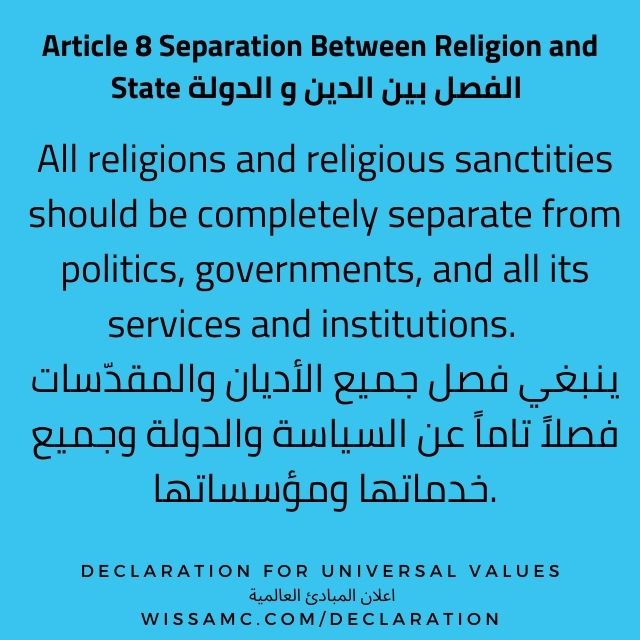
Article 8 – Separation Between Religion and State

Subtitle: Freedom of Belief, Neutrality of Government

All religions and religious sanctities should be completely separate from politics, governments, and all its services and institutions.Ā  Governments can organize and manage religious institutions if need be and consent awarded by members of the said institutions.

A just society requires a clear boundary between religion and state. Article 8 affirms that all religions and religious sanctities should remain separate from politics, government, and public institutions. This principle is not hostile to religion; it is protective of both religion and freedom. When the state adopts, favors, or enforces religious doctrine, faith becomes a tool of power, and citizens of differing beliefs are pushed into inequality. A government worthy of all its people must remain neutral in matters of belief, allowing religion to flourish freely in civil society while ensuring that laws, public services, and political authority are grounded in equal citizenship rather than sectarian preference. The article’s core idea in the book is exactly this separation of religious and political spheres, so that government is not controlled by religious doctrine and religion is not corrupted by state power.  

This separation protects the believer and the nonbeliever alike. It creates a civic space where Muslims, Christians, Jews, Hindus, Buddhists, atheists, agnostics, and everyone else stand equal before the law, without one creed enjoying official privilege over others. The state’s role is not to save souls, certify orthodoxy, or referee divine truth. Its role is to secure liberty, justice, safety, and the common good. History has repeatedly shown that when religion and government fuse too tightly, the result is often coercion, hypocrisy, persecution, and the misuse of sacred language for political domination. The book itself frames this article in that historical tradition: church-state entanglement has too often produced abuses of power, while secular neutrality better protects freedom of belief and equal treatment. 

At the same time, Article 8 leaves room for a limited and carefully bounded administrative role for governments in relation to religious institutions when necessary and when consent is granted by the members of those institutions. That is an important nuance. It does not mean the state should control theology, doctrine, or worship. It means that in certain circumstances—such as questions of legal status, property, public accountability, pligrimage, religious tourism, or institutional administration—the government may help organize or regulate aspects of religious institutions, but only voluntarily and with the consent of the communities involved. In this model, the state remains neutral, religious communities remain autonomous, and both coexist without swallowing each other whole. That is the mature goal of Article 8: a society where freedom of conscience is fully protected, public institutions belong equally to all, and neither priest nor politician gets to masquerade as the other.

Reason Without Humanity Is Not Humanism: Why Sam Harris Should Not Receive the Richard Dawkins Award

The Center for Inquiry says the Richard Dawkins Award honors a person who publicly represents secularism and rationalism, and CFI says its mission is to advance reason, science, freedom of inquiry, and humanist values. Sam Harris may fit the secular-celebrity part of that profile, but I do not believe he fits the humanist part. With Richard Dawkins set to present him the 2026 award in an online ceremony on April 18, this is exactly the moment to ask whether intellectual sharpness without moral clarity is really what CFI wants to celebrate. (Center for Inquiry)

My objection is not that Harris criticized Hamas. Anyone with a functioning conscience condemns the October 7 atrocities. My objection is that Harris has repeatedly framed Israel’s assault on Gaza not as a political catastrophe with history, occupation, dispossession, and civilian annihilation, but as a civilizational morality play. In January 2024 he described the issue as a ā€œclash of culturesā€ in which ā€œreal civilizationā€ exists ā€œonly on one side,ā€ casting the fight as one between jihadists and ā€œordinary human beings.ā€ That framing does not illuminate reality; it bulldozes it. Palestinians disappear as a people with rights and history and reappear only as background scenery in someone else’s war on barbarism. (Sam Harris)

Worse, Harris did not merely defend Israel’s right to respond. He dismissed the very charge of genocide as ā€œpatently false,ā€ mocked it as the ā€œmost inept genocide in history,ā€ and called it a ā€œnew blood libel.ā€ That is not sober skepticism. That is rhetorical contempt aimed at a grave legal and moral question. Amnesty International concluded in December 2024 that Israel is committing genocide in Gaza, and Human Rights Watch found extermination and acts of genocide, with conduct and official statements that may amount to genocidal intent. Human Rights Watch also noted that these policies continued after multiple International Court of Justice provisional measures in 2024 ordering protections for Palestinians in Gaza and humanitarian relief, including water, food, electricity, and fuel. A serious thinker did not have to prejudge every legal question to remain decent here. He only had to refrain from sneering at the possibility while Gaza was being destroyed in real time. (Sam Harris)

Francesca Albanese, the UN Special Rapporteur on the occupied Palestinian territory, has been one of the clearest international voices naming what much of the West refuses to face: in March 2024 she said the ā€œthreshold indicating Israel’s commission of genocide had been met,ā€ and by July 2025 she described Gaza as ā€œone of the cruellest genocides in modern history.ā€ In the official language I could verify, she and fellow UN experts framed Gaza as an ā€œurgent moral crossroadsā€ whose destruction carries ā€œirreversible consequences for our shared humanity and multilateral orderā€ — which is really another way of describing what many people mean by the fall of Western civilization: a moral collapse dressed up as policy. A civilization that excuses genocide in Gaza, tolerates the bombardment and mass displacement of Lebanon, and joins or blesses illegal attacks on Iran while claiming to defend ā€œorderā€ is not defending law at all; Today’s Western civilization is a performing cruel barbaric empire in a suit and tie. UN experts this month called the attack on Iran ā€œentirely illegal under international law,ā€ warned that the forced displacement in Lebanon ā€œwould constitute yet another war crime,ā€ and said this path is pushing the world toward a ā€œmoral and legal abyss.ā€ Add to that the fact that Iran denies seeking nuclear weapons, the U.S. intelligence community said in 2025 that Iran was not building one, and Tehran continues to invoke its NPT right to civilian enrichment, while the IAEA has reiterated that armed attacks on nuclear facilities devoted to peaceful purposes violate the UN Charter and that such facilities ā€œmust never be attacked.ā€ That is the real indictment: what is collapsing before our eyes is not merely the credibility of Western governments, but the pretense that Western civilization still stands for universal law, equal human dignity, or anything beyond selective morality backed by bombs.

That is why I say Harris is not worthy of this award. I am not arguing that he signed an order or pulled a trigger. I am saying that his public language has functioned as moral cover: it narrows sympathy, launders asymmetry, and trains his audience to treat Palestinian suffering as tragic but secondary—an unfortunate price of civilization defending itself. When a public intellectual responds to mass atrocity by ridiculing genocide warnings rather than reckoning with them, he is not modeling rational courage. He is modeling dogmatic ideological loyalty, and that is the furthest from reason. (Sam Harris)

The problem is broader than Gaza. Harris has spent years insisting that his criticism is only about ideas, not people, yet his own language routinely slips from critique of extremists into sweeping claims about Islam itself. He has written that ā€œIslam is the Mother lode of bad ideas,ā€ described a long struggle between ā€œWestern civilization and Islam,ā€ and said ā€œwe are perpetually at warā€ with jihadists while presenting confusion about this as a civilizational failure. In the same period, he claimed the term ā€œIslamophobiaā€ was invented by ā€œIranian theocratsā€ to shut down criticism of Islam. That claim is historically shaky at best: the Oxford English Dictionary traces the word to the 1920s in English, and scholarship cited in search results traces French usage to 1910, long before the Iranian Revolution. (Sam Harris)

And here is the deeper problem: Islam is not just a detachable list of propositions floating in a vacuum. Even by Western standards, Britannica describes Islam as a major world religion, and the ā€œIslamic worldā€ as a complex of societies and cultures in which Muslims and their faith have been socially dominant. One of 4 people on Earth are Muslim, and Islam is as diverse as anthropology itself. The United Nations marks an International Day to Combat Islamophobia because anti-Muslim hatred is not imaginary word-policing; it is a real pattern of hostility directed at people and communities. It is stabbed children, and run over women with cars. So yes, ideas must be criticized, and Islam shall be criticized. But when a writer persistently speaks of Islam in civilizational terms and treats anti-Muslim animus as mostly a semantic trick, he helps create the very climate in which human beings are reduced to abstractions. It is the old white supremacist habit of dehumanization, just appearing now with a podcast microphone and a neuroscience rĆ©sumĆ©. (Encyclopedia Britannica)

The Richard Dawkins Award is supposed to honor secularism, rationalism, and scientific truth. Fine. But secularism without equal human dignity becomes sectarianism for people who pride themselves on not having a sect. Reason that can dissect superstition but cannot recognize mass dehumanization is not moral courage; it is a very polished blind spot. Sam Harris has every right to speak. CFI has every right to honor whom it wishes. But I also have every right to say that giving him this award—during the genocide in Gaza, after his repeated dismissal of genocide claims, and after years of flattening Islam into a near-total explanation of Muslim violence—betrays the humanist values CFI says it stands for. (Center for Inquiry)

If the Richard Dawkins Award is to mean anything, it should go to people who defend reason without abandoning humanity. Sam Harris, in my view, has failed that test. Not because he criticizes religion, but because he does so in a way that too often rationalizes hierarchy, excuses state violence, and treats one population’s fear as tragedy and another population’s destruction as argument. That is more tribalism and less enlightenment (Sam Harris). I would nominate Elen Pappe, Norman Finklestein, or Francesca Albanese herself for defending reason and humanity in the face of the fascist leaning current American dogmatic evangelical zionist administration and Israeli fanatic right government, that is exerting direct pronounced efforts to prohibit even proper language of reason from being used, social media from acting free, and commits a massacre of over 300 journalists in one year to burry reason.

Wissam Charafeddine

CFI Michigan Award Winner of Promotion and Defense of Science, Reason, Free Inquiry & Humanist Values