
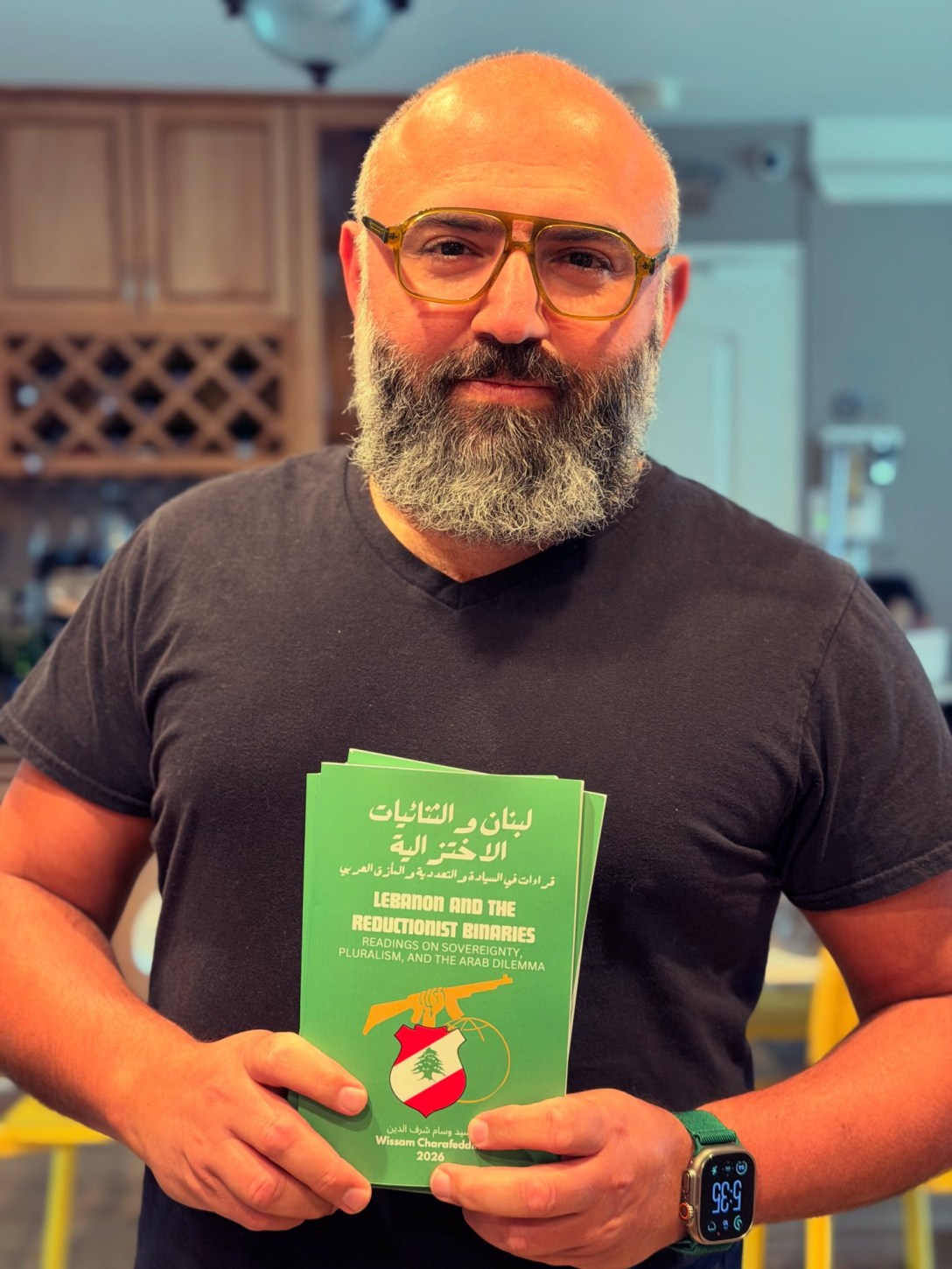
Wissam Charafeddine writes like a man building a legal case for human dignity — methodical, layered, historically grounded, and morally uncompromising. After reading more than a dozen articles from wissamc.com/blog spanning essays, political commentary, cultural reflections, poetry, and his Universal Declaration of Human Values series, a highly distinctive voice emerges: part constitutional drafter, part Arabic orator, part Thomas Paine pamphleteer. His prose marries the precision of political philosophy with the moral urgency of a sermon, delivered in an academic register that never loses its heat. Below is a granular breakdown of every element of his style.
His sentences build like courtroom arguments, then land like verdicts
Charafeddine’s signature sentence is long, multi-clause, and architecturally deliberate. He stacks conditions, qualifications, and historical context before delivering a concluding moral punch. The structure often follows a pattern of “X is not Y, but Z” — a rejection of a false premise followed by a corrected truth.
Representative excerpt (UAE essay):
“The UAE built its greatness on shrewd neutrality and calculated attractiveness; if it surrenders that neutrality in favor of an ideologically orphaned wager in a hostile neighborhood, it will find itself in the position of the regretful: neither secure within its regional surroundings, nor appealing in the eyes of investors who seek tranquility before they seek profits.”
Notice the cadence: a confident historical claim (“built its greatness”), a conditional warning (“if it surrenders”), a metaphor (“ideologically orphaned wager”), and a concluding parallelism (“neither… nor…”). This is his default rhythm in formal essays.
He also uses short, blunt declaratives to close long analytical passages, creating a dramatic shift in tempo:
“I will not choose a killer, no matter how ‘lesser’ the evil. I will not drive the train of death, even if it is presented as the only solution. I will not submit.” (from “We will not vote for the ‘less bloody’”)
“It is time to wake up.” (from “It is time to wake up”)
This alternation — long analytical buildups followed by short moral declarations — is perhaps his most recognizable cadence. He writes like someone constructing a palace of logic, then slamming the door shut with a single sentence.
Arabic-Islamic concepts flow seamlessly into Western political thought
Charafeddine never code-switches awkwardly between traditions. He weaves Arabic and Islamic concepts into Enlightenment-style arguments as if they were always part of the same conversation. This is a defining feature of his voice.
Islamic concepts deployed naturally:
• He references Wilayat al-Faqih (governance of the jurist) while discussing Lebanese party politics, treating it as a normal political-philosophical concept worthy of analysis, not exotic
• His reinterpretation of Al-Fatiha (the opening chapter of the Quran) is rendered in a contemplative, almost secular-spiritual register: “Compassion that meets every wound with patience and healing, Mercy that grants space to fail, to learn, to begin again”
• He invokes مقاصد الشريعة (the objectives of Islamic jurisprudence) to argue for secular civil governance: “The Islamic tradition is full of indications that what is intended is the ordering of people’s interests and the removal of harm from them”
• The concept of “الدولة العربية المنتظرة” (The Awaited Arab State) deliberately echoes Shia messianic language while being deployed as a practical political framework
How he bridges traditions:
In the Lebanon essay, he writes that Islam “did not make the form of the political system a pillar of faith” and that its core demands are “justice, consultation, the lifting of oppression, the safeguarding of rights, the prevention of tyranny, and the preservation of human dignity.” He then immediately connects this to secular governance: “The Islam that, as we believe, is a religion of justice and mercy and dignity and responsibility — the closest states to its spirit are not those that raise religious slogans highest, but those that prevent injustice most.”
His reading list is revealing: Thomas Paine’s Common Sense sits alongside books on early Islam and Arab nationalism. He explicitly identifies with Paine. He references John Locke, Voltaire, John Stuart Mill, Hannah Arendt, Amartya Sen, Edward Said, Gibran Khalil Gibran, al-Kawakibi, Malek Bennabi, and Mohamed Arkoun — all in the same intellectual breath.
Key stylistic move: He treats Arabic/Islamic political philosophy and Western Enlightenment thought as parallel rather than competing traditions, and positions himself as someone who inherits both.
History is never background — it is the engine of his moral arguments
Charafeddine does not use history as decoration. Historical analysis IS his argument. He builds the moral case by first establishing the historical record, then showing how the present violation is a continuation of the same pattern.
Representative technique (Lebanon essay):
He traces the creation of “Greater Lebanon” in 1920 under French mandate, documents how Jabal Amil was severed from its natural extension toward Galilee, cites the 1923 border adjustment that transferred Shia villages to the Palestine side, names specific treaties and dates (the Hague Regulations of 1907, the Taif Accord), and then pivots to the moral conclusion: “Lebanon cannot escape Israel by denying Palestine, just as it cannot create a magical neutrality in the face of an expansionist colonial project that has never recognized the moral or geographic boundaries of aggression.”
The move is always the same: (1) Establish the colonial origin of the current structure, (2) show that the structure was imposed against the will of the people, (3) demonstrate that its contradictions persist, (4) conclude that moral clarity requires acknowledging this history.
In the Trump essay: He traces “gendered Orientalism” through scholarship, then connects it directly to Trump’s February 28 statement (“the hour of your freedom is at hand”), and concludes: “Notice the trick. Bomb first. Speak of freedom second. Call it liberation third. Same movie, new poster.”
In the Robert de Caix piece: He resurrects an obscure French colonial official who “doesn’t even have a Wikipedia English page” and shows how de Caix’s strategies of divide-and-rule (“converting the image to be Muslims vs. Christians”) created the political architecture Arabs still inhabit.
Calm academic surface, white-hot moral urgency underneath
The description of his tone as “academic calm Islamic Arabic humanitarian Thomas Paine” is precise. He maintains scholarly register — citing specific articles, legal definitions, named scholars, exact dates — while building to statements of absolute moral conviction.
The academic layer: He quotes the Hague Regulations Article 42 to define “occupation” legally. He references a 2018 paper in The Philosophical Quarterly by Helen Frowe on the trolley problem. He cites Carnegie analysis of Hezbollah’s political integration. He names Human Rights Watch and Amnesty International reports.
The moral layer (always arrives):
“The economy must serve the human being, not the other way around. Labor is not servitude, profit is not permission for exploitation, and vulnerability is not a license for oppression.” (Article 9)
“From one who uprooted a people from their land, occupied South Lebanon, and bombed Beirut — he does not suddenly become a natural neighbor just because some Lebanese have grown tired of the conflict or weary of its costs.” (Lebanon essay)
“Silence is complicity in murder, even if on a smaller scale.” (“We will not vote”)
The moral declarations never feel like emotional outbursts because they arrive only after extensive evidentiary foundation. This is the Paine parallel — Common Sense works the same way: patient exposition, then a moral thunderclap.
His vocabulary is precise, elevated, and metaphorically rich
Characteristic vocabulary choices:
• “Ideologically orphaned wager” — his metaphors are unusual and specific
• “International capital is timid by nature, fleeing any horizon where uncertainty lurks at its edges” — personification of abstract forces
• “Calculated attractiveness,” “shrewd neutrality” — two-word compressed characterizations
• “Colonial prison guards,” “dictator statelets” — compound coinages
• “The bloodstained Zionist fold” — vivid but controlled imagery
• “A sphere of productive freedom ordered toward human flourishing” — Aristotelian register
• “Hot brown water with existential dread on the side” — sudden humor in lighter pieces
He favors abstract nouns deployed in concrete chains: “justice, consultation, the lifting of oppression, the safeguarding of rights, the prevention of tyranny, and the preservation of human dignity.” These chains — always in threes or more — give his prose its declaratory, quasi-constitutional rhythm.
Words he uses constantly: justice, dignity, freedom, accountability, humanity, sovereignty, resistance, colonial/colonialism, oppression, empire, conscience, moral, civilization/civilizational, truth, silence, complicity.
Words he avoids: hedging language. He almost never writes “perhaps,” “maybe,” “it could be argued.” When uncertain, he states uncertainty directly rather than hedging. He writes “this is not X, but Y” rather than “this might be Y.”
Paragraphs are long and dense in essays, short and punchy in personal pieces
Formal essays: Paragraphs run 6-12 sentences, each building one complete argument. The Arabic sections of the Lebanon essay contain paragraphs exceeding 200 words. He does not break for visual relief — he assumes the reader will follow the argument.
Personal/cultural pieces (Ode to Astros): Paragraphs drop to 1-3 sentences, and the register shifts to conversational, warmly irreverent: “Also — very important — real plants. Not plastic Chinese imports made by underpaid, over surveilled laborers. Real ones that struggle a little.”
Declaration articles (UDHV series): Three tight paragraphs, each performing a distinct function: (1) state the principle, (2) develop the argument, (3) deliver the moral conclusion. These are the most disciplined in structure.
Openings grab with bold framing; closings deliver moral verdicts
Characteristic openings:
• Direct provocation: “Trump’s attack on Iran has been wrapped in shifting justifications: nuclear danger, missile threats, freedom for the Iranian people, and now threats against civilian infrastructure. But behind the changing script sits an older Western habit…”
• Bold thesis statement: “When the UAE bets on its alliance with the Zionist project in a region where new Iranian alliances are redrawing the maps of influence, it is not betting on a partner — it is betting on a burden.”
• Conditional moral framing: “If someone must die, let it be the ‘less harmful’ option — this is how the logic of ‘the lesser evil’ simplifies moral dilemmas in times of crisis. But what if all options are evil?”
• Staccato declaration: “Israel has military and security agreements with 157 countries. It is a non-member ally to NATO…”
He never opens with throat-clearing or pleasantries. The first sentence always contains a claim, a contradiction, or a challenge.
Characteristic closings:
• Moral crescendo with short declarations: “I will not choose a killer, no matter how ‘lesser’ the evil. I will not drive the train of death, even if it is presented as the only solution. I will not submit.”
• Synthesizing restatement: “No future for Lebanon without a resistance that protects it, nor without a just state that builds it, nor without a broader Arab horizon that supports it, nor without a civil secular state that safeguards its diversity.”
• Simple imperative after long analysis: “It is time to wake up.”
• Reframing the question: “The issue is not who loves Lebanon and who hates it; the issue is how we protect it from the outside, and how we build it from within, without lying to ourselves, and without slaughtering truth on the altar of slogans.”
Recurring rhetorical moves and signature patterns
- The false-binary demolition: His most frequent structural move. He identifies a reductive either/or, rejects both sides, and offers a third way. “Article 9 rejects two false choices at once.” The entire Lebanon essay is 12 sections of binary demolition.
- The “not X, but Y” correction: Used in nearly every essay. “The problem is not A, but B.” “This is not charity, but justice.” “Not the path of forgetting, nor the path of turning away.”
- The bilingual mirror: Many pieces are written in Arabic first, then translated to English (or vice versa), presented side by side. This bilingual architecture is a stylistic signature — it signals his dual audience and dual intellectual inheritance.
- The historical pivot: He establishes a historical fact, then immediately turns it into a present-tense moral claim. “He worked hard against Wilsonian principles and fought against the establishment of Arab State” → implication: this is still happening.
- The sardonic aside: Deployed sparingly but distinctively. “Notice the trick. Bomb first. Speak of freedom second. Call it liberation third. Same movie, new poster.” Or from the café piece: “the one grandmother that read Nietzsche.”
- The cascading list of moral demands: He builds chains of parallel clauses, often in the form of “neither… nor…” or “not… but…” sequences that accumulate rhetorical force: “neither secure within its regional surroundings, nor appealing in the eyes of investors who seek tranquility before they seek profits.”
- The constitutional register: His UDHV articles consciously echo the syntax and gravity of constitutional documents. He opens with the article text in bold (like a legal code), then writes interpretive commentary in the tradition of legal scholarship.
- Direct address to power: He speaks to nations, leaders, and institutions as if they can hear him. “We hope it reconsiders the failed normalization project.” “We will not vote for the ‘less bloody.’” This gives even his analytical prose a pamphleteer quality.
The unified voice beneath all the registers
Across all these genres — formal political essays, cultural elegies, poems, human rights declarations, Arabic-language analysis — the core voice remains constant: a man who believes deeply in the unity of the Arab-Islamic intellectual tradition with Enlightenment values, who insists that moral clarity is not naive but necessary, who treats historical knowledge as a precondition for ethical action, and who refuses to accept that the world as it is must remain so.
His tone never becomes shrill. His anger is structural, not emotional — it is expressed through the relentless accumulation of evidence rather than through shouting. When he does raise his voice, it comes as a sudden simplification after pages of complexity: three short sentences after twelve long paragraphs. That contrast — the calm of the analysis and the force of the conclusion — is the heartbeat of his style.
He writes as if he is drafting the founding documents of a civilization that does not yet exist but must.

