
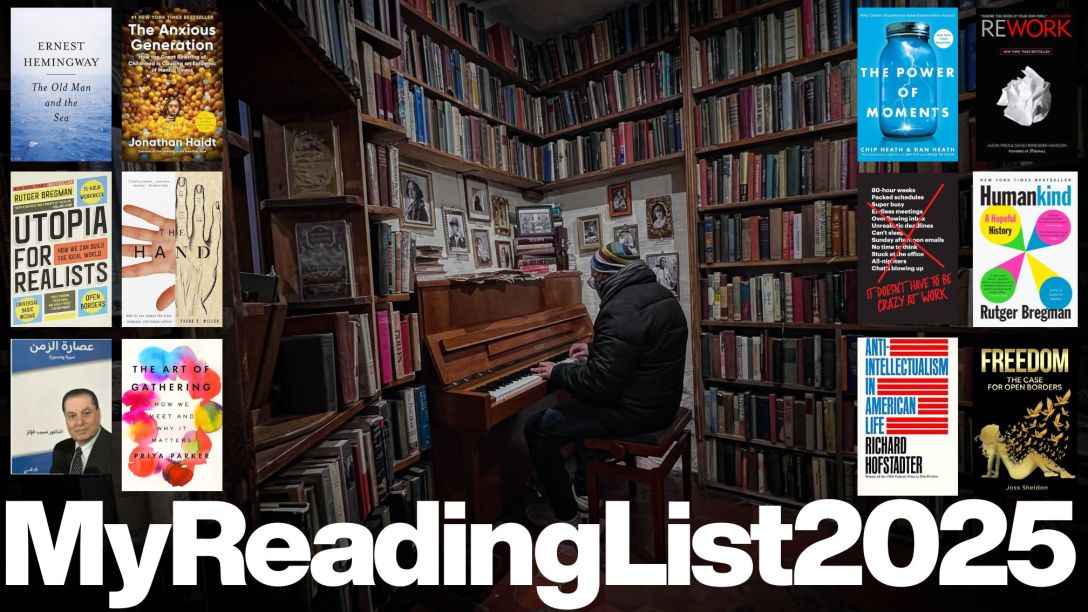
2025 was a “multiple tabs open” kind of year. This reading stack is the stuff that kept me grounded, suspicious of hustle-culture, allergic to propaganda, and still soft enough to believe humans can be better than the systems we’re trapped in.
The image says it all: me in a bookstore-library maze, sitting at a piano, surrounded by stories and ideas like they’re sheet music. That’s basically my whole philosophy in one frame. Reading is how I tune my mind back to the right key—especially when the world is loud, cruel, and trying to sell you distraction as destiny.
Below is my 2025 list based on the covers in the collage—what each book gave me, and why it mattered.
1) The Anxious Generation — Jonathan Haidt
This book is a huge cultural Rorschach test. Haidt argues we’ve shifted from a “play-based childhood” to a “phone-based childhood,” and that it’s tied to rising youth anxiety and depression. Wikipedia+1
What I took from it wasn’t “phones bad, throw them in the river like a cursed ring.” It was the bigger point: design matters. If an environment is engineered to hijack attention, then pretending it’s just “personal responsibility” is lazy. That said, the science and causality claims are actively debated—Candice Odgers’ review in Nature argues the book overstates what the evidence can support, and The Guardian summarized similar critiques. Nature+2Psychological Effects of the Internet+2
My 2025 vibe: take the parts about childhood freedom, sleep, and community seriously—without turning it into a moral panic that ignores poverty, racism, trauma, and all the other very real drivers of mental distress.
2) Rework — Jason Fried & David Heinemeier Hansson
This is the anti-hustle manifesto for people who are tired of business bros talking like they invented breathing. The core idea: you don’t need endless meetings, performative scaling, or stress as a personality to build something real. Google Books+1
For me, Rework lands because it treats calm as competence. That’s radical in a culture that mistakes exhaustion for virtue.
3) It Doesn’t Have to Be Crazy at Work — Fried & Hansson
Same authors, more focused punch: stop worshipping “crazy” and start building workplaces that don’t chew people up for productivity optics. Even the publisher description basically says: celebrate calm, not chaos. Amazon+1
If you’re organizing, building projects, running campaigns, or just trying to survive capitalism with your soul intact—this one is a needed reset.
4) Utopia for Realists — Rutger Bregman
UBI (universal basic income), shorter workweeks, open borders—the book is basically Bregman saying: “your imagination has been privatized; let’s steal it back.” Wikipedia+1
What I respect is the insistence that “realism” doesn’t mean accepting cruelty as policy. It means asking what’s possible if we stop treating human suffering as a budget line item.
5) Humankind: A Hopeful History — Rutger Bregman
This one pairs perfectly with Utopia for Realists. Bregman argues that humans are more cooperative—and more shaped by context—than the cynical “people are trash” narrative suggests. Hachette Book Group+1
And look, I’m not naïve. The world provides receipts every day. But cynicism is also a scam: it makes people easier to govern and harder to mobilize. This book is an antidote to that.
6) Freedom: The Case for Open Borders — Joss Sheldon
Open borders is one of those ideas that gets dismissed as “too extreme” mostly because we’ve normalized the extreme violence of borders. This book makes a full-spectrum argument—historical, economic, cultural, philosophical—for freer movement. It was published in 2024, so it’s a newer addition to this conversation. Amazon+1
For Dearborn—and for anyone living diaspora life—this hits differently. When your community’s story includes migration, exile, and paperwork as fate, “freedom of movement” stops being abstract. It becomes personal.
7) Anti-Intellectualism in American Life — Richard Hofstadter
Published in 1963 and winner of the 1964 Pulitzer Prize for General Nonfiction, this book traces America’s long tradition of distrusting expertise, thought, and learning—especially when it challenges power. Wikipedia+1
Reading this in 2025 felt like watching an origin story for the current era: conspiracies, anti-science culture wars, loud confidence with zero homework. Hofstadter doesn’t just drag people—he explains the social conditions that make anti-intellectualism feel comforting.
8) The Power of Moments — Chip Heath & Dan Heath
This book explores why certain experiences become “defining moments,” and how we can design moments that create meaning—at work, in community, in life. Heath Brothers+2Simon & Schuster+2
I read it like an organizer: movements aren’t only built on strategy; they’re built on memory. People stay involved because of moments where they felt seen, brave, connected, and useful. That’s not sentimental. That’s logistics for the human heart.
9) The Art of Gathering — Priya Parker
Parker argues that most gatherings are bland because we don’t design them with intention—and she offers a practical way to make coming together meaningful again. Priya Parker+1
This is quietly political. “How we gather” shapes “what we become.” A strong community doesn’t happen by accident; it’s built—like infrastructure, like habit, like love.
10) The Hand — Frank R. Wilson
Published in 1998, The Hand digs into how the evolution and use of our hands shaped the brain, creativity, language—basically: civilization is a craft project. PenguinRandomhouse.com+1
I love books like this because they pull you out of doomscroll reality and remind you: humans make things. We’re not only consumers of chaos; we’re builders of meaning.
Bonus classics and roots
The Old Man and the Sea — Ernest Hemingway
A 1952 novella about an aging fisherman’s struggle with a giant marlin; it won the 1953 Pulitzer Prize for Fiction. Wikipedia
This is one of the cleanest stories ever written about dignity, stubbornness, and what it means to keep going when life is actively disrespecting you.
عصارة الزمن: سيرة ومسيرة — الدكتور نسيب فواز
The Arabic memoir in the collage appears to be “عصارة الزمن: سيرة ومسيرة” by Dr. نسيب فواز—a life-and-journey story tied to Lebanese diaspora life (including community visibility in Michigan). Al Binaa+2halasour \ هلا صور+2
This one matters to me because our communities aren’t just “immigrant success stories.” We’re archives. We’re memory. We’re proof that identity survives distance.
The through-line (because yes, I noticed the pattern)
This list is basically three rebellions in book form:
- Rebellion against distraction (Anxious Generation, Power of Moments)
- Rebellion against burnout (Rework, Crazy at Work)
- Rebellion against cruelty as “policy” (Utopia for Realists, Freedom, Humankind)
And then Hofstadter shows up like: “Also, your country has a long-standing allergy to thinking, good luck.” Fair.
Disclaimer: This is a personal reading list and commentary, not mental health, legal, or financial advice. Book interpretations are subjective, and editions/titles may vary by region.
Sources / book references (for factual details)
The Anxious Generation — https://en.wikipedia.org/wiki/The_Anxious_Generation
Nature review (Odgers) — https://www.nature.com/articles/d41586-024-00902-2
The Guardian critique roundup — https://www.theguardian.com/books/2024/apr/27/anxious-generation-jonathan-haidt

Rework (Google Books) — https://books.google.com/books/about/Rework.html?id=3oSoqGOmI4sC
It Doesn’t Have to Be Crazy at Work (37signals) — https://37signals.com/podcast/it-doesnt-have-to-be-crazy-1/

Utopia for Realists — https://en.wikipedia.org/wiki/Utopia_for_Realists
Humankind (publisher) — https://www.littlebrown.com/titles/rutger-bregman/humankind/9780316418539/

Freedom: The Case for Open Borders (pub date) — https://www.amazon.com/Freedom-Case-Borders-Joss-Sheldon/dp/B0CT89PL5R

Anti-Intellectualism in American Life — https://en.wikipedia.org/wiki/Anti-intellectualism_in_American_Life
Pulitzer page — https://www.pulitzer.org/winners/richard-hofstadter-0

The Power of Moments (Heath brothers) — https://heathbrothers.com/the-power-of-moments/
The Art of Gathering (Priya Parker) — https://www.priyaparker.com/book-art-of-gathering

The Hand (publisher) — https://www.penguinrandomhouse.com/books/191866/the-hand-by-frank-r-wilson/
The Old Man and the Sea — https://en.wikipedia.org/wiki/The_Old_Man_and_the_Sea

عصارة الزمن / نسيب فواز coverage — https://www.al-binaa.com/archives/429072










 Wissam Charafeddine