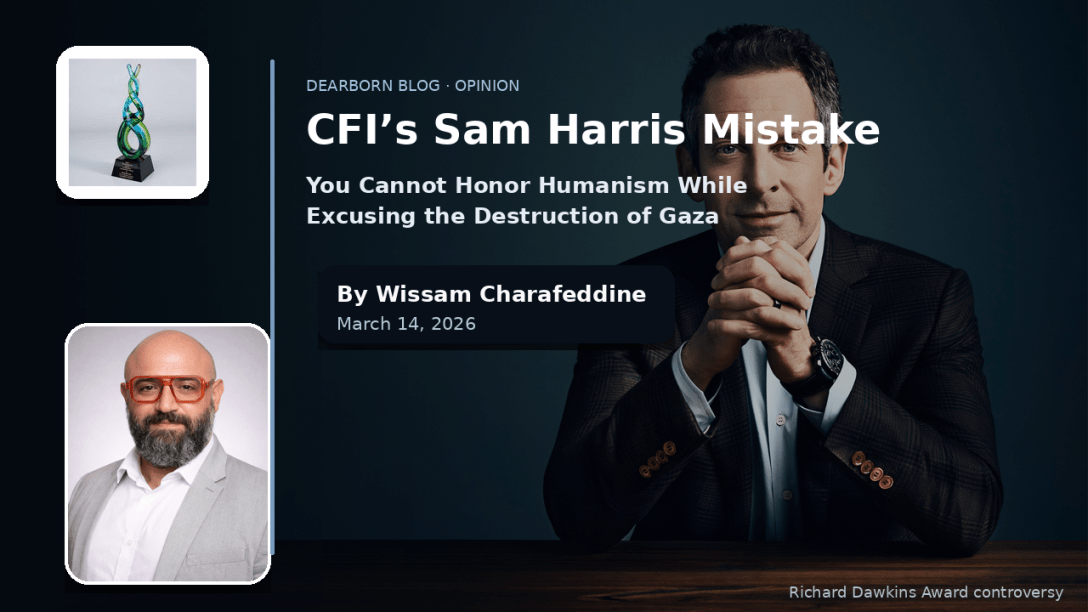
Reason Without Humanity Is Not Humanism: Why Sam Harris Should Not Receive the Richard Dawkins Award

The Center for Inquiry says the Richard Dawkins Award honors a person who publicly represents secularism and rationalism, and CFI says its mission is to advance reason, science, freedom of inquiry, and humanist values. Sam Harris may fit the secular-celebrity part of that profile, but I do not believe he fits the humanist part. With Richard Dawkins set to present him the 2026 award in an online ceremony on April 18, this is exactly the moment to ask whether intellectual sharpness without moral clarity is really what CFI wants to celebrate. (Center for Inquiry)

My objection is not that Harris criticized Hamas. Anyone with a functioning conscience condemns the October 7 atrocities. My objection is that Harris has repeatedly framed Israelโ€™s assault on Gaza not as a political catastrophe with history, occupation, dispossession, and civilian annihilation, but as a civilizational morality play. In January 2024 he described the issue as a โ€œclash of culturesโ€ in which โ€œreal civilizationโ€ exists โ€œonly on one side,โ€ casting the fight as one between jihadists and โ€œordinary human beings.โ€ That framing does not illuminate reality; it bulldozes it. Palestinians disappear as a people with rights and history and reappear only as background scenery in someone elseโ€™s war on barbarism. (Sam Harris)

Worse, Harris did not merely defend Israelโ€™s right to respond. He dismissed the very charge of genocide as โ€œpatently false,โ€ mocked it as the โ€œmost inept genocide in history,โ€ and called it a โ€œnew blood libel.โ€ That is not sober skepticism. That is rhetorical contempt aimed at a grave legal and moral question. Amnesty International concluded in December 2024 that Israel is committing genocide in Gaza, and Human Rights Watch found extermination and acts of genocide, with conduct and official statements that may amount to genocidal intent. Human Rights Watch also noted that these policies continued after multiple International Court of Justice provisional measures in 2024 ordering protections for Palestinians in Gaza and humanitarian relief, including water, food, electricity, and fuel. A serious thinker did not have to prejudge every legal question to remain decent here. He only had to refrain from sneering at the possibility while Gaza was being destroyed in real time. (Sam Harris)

Francesca Albanese, the UN Special Rapporteur on the occupied Palestinian territory, has been one of the clearest international voices naming what much of the West refuses to face: in March 2024 she said the โ€œthreshold indicating Israelโ€™s commission of genocide had been met,โ€ and by July 2025 she described Gaza as โ€œone of the cruellest genocides in modern history.โ€ In the official language I could verify, she and fellow UN experts framed Gaza as an โ€œurgent moral crossroadsโ€ whose destruction carries โ€œirreversible consequences for our shared humanity and multilateral orderโ€ โ€” which is really another way of describing what many people mean by the fall of Western civilization: a moral collapse dressed up as policy. A civilization that excuses genocide in Gaza, tolerates the bombardment and mass displacement of Lebanon, and joins or blesses illegal attacks on Iran while claiming to defend โ€œorderโ€ is not defending law at all; Today’s Western civilization is a performing cruel barbaric empire in a suit and tie. UN experts this month called the attack on Iran โ€œentirely illegal under international law,โ€ warned that the forced displacement in Lebanon โ€œwould constitute yet another war crime,โ€ and said this path is pushing the world toward a โ€œmoral and legal abyss.โ€ Add to that the fact that Iran denies seeking nuclear weapons, the U.S. intelligence community said in 2025 that Iran was not building one, and Tehran continues to invoke its NPT right to civilian enrichment, while the IAEA has reiterated that armed attacks on nuclear facilities devoted to peaceful purposes violate the UN Charter and that such facilities โ€œmust never be attacked.โ€ That is the real indictment: what is collapsing before our eyes is not merely the credibility of Western governments, but the pretense that Western civilization still stands for universal law, equal human dignity, or anything beyond selective morality backed by bombs.

That is why I say Harris is not worthy of this award. I am not arguing that he signed an order or pulled a trigger. I am saying that his public language has functioned as moral cover: it narrows sympathy, launders asymmetry, and trains his audience to treat Palestinian suffering as tragic but secondaryโ€”an unfortunate price of civilization defending itself. When a public intellectual responds to mass atrocity by ridiculing genocide warnings rather than reckoning with them, he is not modeling rational courage. He is modeling dogmatic ideological loyalty, and that is the furthest from reason. (Sam Harris)

The problem is broader than Gaza. Harris has spent years insisting that his criticism is only about ideas, not people, yet his own language routinely slips from critique of extremists into sweeping claims about Islam itself. He has written that โ€œIslam is the Mother lode of bad ideas,โ€ described a long struggle between โ€œWestern civilization and Islam,โ€ and said โ€œwe are perpetually at warโ€ with jihadists while presenting confusion about this as a civilizational failure. In the same period, he claimed the term โ€œIslamophobiaโ€ was invented by โ€œIranian theocratsโ€ to shut down criticism of Islam. That claim is historically shaky at best: the Oxford English Dictionary traces the word to the 1920s in English, and scholarship cited in search results traces French usage to 1910, long before the Iranian Revolution. (Sam Harris)

And here is the deeper problem: Islam is not just a detachable list of propositions floating in a vacuum. Even by Western standards, Britannica describes Islam as a major world religion, and the โ€œIslamic worldโ€ as a complex of societies and cultures in which Muslims and their faith have been socially dominant. One of 4 people on Earth are Muslim, and Islam is as diverse as anthropology itself. The United Nations marks an International Day to Combat Islamophobia because anti-Muslim hatred is not imaginary word-policing; it is a real pattern of hostility directed at people and communities. It is stabbed children, and run over women with cars. So yes, ideas must be criticized, and Islam shall be criticized. But when a writer persistently speaks of Islam in civilizational terms and treats anti-Muslim animus as mostly a semantic trick, he helps create the very climate in which human beings are reduced to abstractions. It is the old white supremacist habit of dehumanization, just appearing now with a podcast microphone and a neuroscience rรฉsumรฉ. (Encyclopedia Britannica)

The Richard Dawkins Award is supposed to honor secularism, rationalism, and scientific truth. Fine. But secularism without equal human dignity becomes sectarianism for people who pride themselves on not having a sect. Reason that can dissect superstition but cannot recognize mass dehumanization is not moral courage; it is a very polished blind spot. Sam Harris has every right to speak. CFI has every right to honor whom it wishes. But I also have every right to say that giving him this awardโ€”during the genocide in Gaza, after his repeated dismissal of genocide claims, and after years of flattening Islam into a near-total explanation of Muslim violenceโ€”betrays the humanist values CFI says it stands for. (Center for Inquiry)

If the Richard Dawkins Award is to mean anything, it should go to people who defend reason without abandoning humanity. Sam Harris, in my view, has failed that test. Not because he criticizes religion, but because he does so in a way that too often rationalizes hierarchy, excuses state violence, and treats one populationโ€™s fear as tragedy and another populationโ€™s destruction as argument. That is more tribalism and less enlightenment (Sam Harris). I would nominate Elen Pappe, Norman Finklestein, or Francesca Albanese herself for defending reason and humanity in the face of the fascist leaning current American dogmatic evangelical zionist administration and Israeli fanatic right government, that is exerting direct pronounced efforts to prohibit even proper language of reason from being used, social media from acting free, and commits a massacre of over 300 journalists in one year to burry reason.

Wissam Charafeddine

CFI Michigan Award Winner of Promotion and Defense of Science, Reason, Free Inquiry & Humanist Values
Blueprint or Band-Aid? Why Thomas Barrack’s โ€œLevant Peaceโ€ Pitch Misses the Mark

Who Is Tom Barrack, and Why His โ€œLevant Peaceโ€ Vision Matters Now

Thomas J. Barrack Jr. is not a diplomat by training, nor an academic specialist in Middle Eastern affairs. He is a billionaire real-estate investor, founder of Colony Capital, longtime confidant of Donald J. Trump, and one of the architects behind the Trump Administrationโ€™s Middle East economic agenda during its first term. In Washington and Riyadh circles he is often described as a bridge-builder between American capital and Gulf monarchies, a man who speaks the language of both high finance and regional power.

Barrackโ€™s latest essay, โ€œA Personal Perspective โ€“ Syria and Lebanon Are the Next Pieces for Levant Peace,โ€ published in mid-October 2025, positions him as an unofficial herald of the Trump-era return to Middle Eastern grand strategy.ยน The article praises the October 13 Sharm el-Sheikh summitโ€”where world leaders endorsed President Trumpโ€™s โ€œTwenty-Point Visionโ€ for renewal and reconstructionโ€”as a turning point toward what Barrack calls an โ€œarchitecture of peace.โ€ In his telling, the Gaza ceasefire was merely the overture; the next movements are the stabilization of Syria and the disarmament of Hezbollah in Lebanon.

Politically, his piece lands at a charged moment. The Trump administration, restored to power after the 2024 election, has revived the Abraham Accords framework and expanded it into a broader โ€œLevant Peace Initiative,โ€ aimed at drawing Syria, Lebanon, and eventually Iraq into normalization with Israel. At the same time, Washington has begun to roll back sanctions on Damascus, arguing that the โ€œnew Syrian governmentโ€ formed in December 2024 warrants economic reintegration.ยฒ Meanwhile, U.S. and French envoys are pressing Beirut to curb Hezbollahโ€™s influence and accept a phased disarmament plan linked to Gulf reconstruction aid.ยณ

Barrack casts these developments as historic progress: sanctions transformed into investment, militias replaced by โ€œlegitimate forces,โ€ and regional alignment against Iran framed as moral renewal. He praises Congress for moving toward repeal of the Caesar Syria Civilian Protection Act and urges Lebanon to โ€œalign with the anti-terrorist rhythm of its region.โ€โด

The subtext, however, is unmistakably political. His essay serves as a soft-power extension of the Trump administrationโ€™s broader projectโ€”using economic incentives and normalization deals to reshape the Middle East without addressing the root causes of instability: occupation, inequality, and foreign interference. In this light, โ€œLevant Peaceโ€ reads less like a diplomatic blueprint and more like a shareholderโ€™s prospectus for a new U.S.-led regional order.

From our Arabic perspective โ€” grounded in the principles of human dignity, honor, and sovereignty, anti-imperialism, and self-determination โ€” Tom Barrackโ€™s piece is an elegant mask on a deeply colonial argument. It recycles the same logic that has long underwritten Western interventions in the Middle East: that peace can be engineered from Washington or Tel Aviv, that Arab nations must โ€œproveโ€ their modernity by aligning with American-Israeli strategic goals, and that sovereignty is a gift bestowed from the outside rather than a right defended from within.

Barrackโ€™s prose is honeyed, but the poison is in the premise. Letโ€™s take it apart.


1. The โ€œTrump Doctrineโ€ as benevolent empire

Barrack frames Trumpโ€™s โ€œtwenty-point planโ€ as a renewal of the region โ€” a โ€œbold visionโ€ replacing โ€œfear with optimism.โ€ Yet, in practice, this โ€œvisionโ€ mirrors the logic of the Abraham Accords: peace without justice, normalization without liberation, reconstruction on the skulls of children. The Palestinians, whose dispossession is the moral and political nucleus of the regionโ€™s conflict, are reduced to scenery in a Trumpian tableau of โ€œprosperity.โ€

He claims Gazaโ€™s ceasefire marks the start of a โ€œmosaic of partnership,โ€ but ignores the grotesque asymmetry of power at play: With about 200,000 tons of explosives… equivalent to 13 nuclear bombs, Gaza was bombed into submission , not invited into cooperation. To praise โ€œpeace through shared opportunityโ€ while hundreds of thousands remain displaced, starved, or buried under rubble, is to mistake silence for harmony.

This is not diplomacy โ€” it is damage control for genocide, ethnic cleansing, and war crimes dressed in corporate language.

The first item of business is to set war crime tribunals and arrest Netenyahu. Is to stop the famine and reduce the risk of death for the 100’s of thousands of children, women, and men of Gaza. Is to provide shelter, and bury the dead, and bring healthy water and medicine. Is to release all palestinian hostages that are being raped and tortured, eyes blinded with electricity, legs amputated after torture, and faces implanted with the israeli version of swastikas. There is no diplomacy amidst a Genocide unless you count Arabs as you counted buffalos in the newly discovered Turtle Island.


2. Syria: Sanctions are not the central problem โ€” sovereignty is

Barrackโ€™s call to repeal the Caesar Act seems, on the surface, humane. Indeed, U.S. sanctions have crippled civilians far more than elites, and ending them could be a step toward recovery. But Barrackโ€™s reasoning is not humanitarian; itโ€™s transactional. He describes the repeal as โ€œstrategy,โ€ a way to โ€œunlock investors,โ€ โ€œunleash reconstruction,โ€ and โ€œsignal to allies.โ€ In other words, he wants Syria reopened to Western and Gulf capital โ€” not to Syrian agency.

When he praises the โ€œnew Syrian governmentโ€ that arose after December 8, 2024, he treats it as if Damascus were rebooted like a corporate board, conveniently absolving the same foreign powers who weaponized sanctions and proxy wars in the first place. True recovery cannot come from conditional Western โ€œpartnershipsโ€ tied to alignment with Israelโ€™s regional framework. It must come from the Syrian people determining their political future free of imperial bargaining.

Also, there is total ignoring of the war crime of an expanded occupation of Syria in 2024. Barack didn’t mention the grave breaches of international humanitarian law, specifically theย Fourth Geneva Convention, nor the war crime of forced displacement of Syrian civiliansย from their homes (prohibited under Article 49 of the Fourth Geneva Convention), the extensive and unjustifiedย destruction and confiscation of civilian propertyย and agricultural land not required by absolute military necessity, and theย unlawful transfer of Syrian detainees into Israeli territory. Furthermore, the establishment of permanent military control and the stated intent to hold the territory indefinitely violate the principle that occupation is a temporary state and that acquiring territory by force is illegal under the UN Charter, with such actions also potentially amounting to a crime of aggression.

Golan Heights which has been since 1967 under long-standing occupation covers about 1,200 sq km (460 sq mi), but since the collapse of the Assad regime in December 2024, Israel has expanded its control into the UN Disengagement Observer Force (UNDOF) buffer zone and surrounding parts of the Quneitra and Daraa governorates with an incursion zone reaching approximately 600 sq km. This expansion has brought the total occupied Syrian land mass to well over 1,700 sq km, which is almost triple the size of the country of Bahrain.


3. Lebanon: A sovereign nation, not an Israeli security project

Barrackโ€™s prescription for Lebanon is the most revealing โ€” and the most dangerous. He calls Hizballahโ€™s disarmament โ€œLebanonโ€™s opportunity for renewal,โ€ framing it as both an Israeli security need and an American economic incentive. He argues that U.S. and French โ€œoversightโ€ of Lebanese reconstruction, tied to disarmament, is a path to sovereignty. This is doublethink.

No genuine sovereignty can coexist with conditions imposed by foreign powers. To demand that Lebanon โ€œalign with the anti-terrorist rhythm of its regionโ€ โ€” meaning, align with U.S. and Israeli military objectives โ€” is to erase the countryโ€™s complex pluralism and replace it with a single acceptable rhythm: obedience.

The core of Lebanonโ€™s paralysis is not Hizballah alone but the continuous and daily state terrorism practiced by Israel on South Lebanon since 1978, including 4 invasions one of which took over the Capital city of Beirut, and the sectarian system created by French colonial design, sustained by Saudi and Western patronage, and manipulated by Washington whenever convenient. To single out Hizballahโ€™s weapons as the cause of all Lebanese decay is a false simplification. The real question is why the U.S. and its allies continue to block Lebanonโ€™s economic recovery and political reform unless it conforms to Israelโ€™s definition of โ€œpeace.โ€


4. Iran as eternal villain

Barrackโ€™s essay requires a perpetual antagonist โ€” and Iran fits perfectly. He paints the Islamic Republic as โ€œterminally weakened, morally bankrupt, and treacherous,โ€ a kind of necessary evil whose eradication justifies every American maneuver. This caricature allows him to frame Trumpโ€™s peace plan as anti-terrorism rather than anti-sovereignty. Yet the reality is that Iranโ€™s influence in the Levant exists largely because of U.S. and Israeli wars that shattered Iraq, strangled Syria, and left power vacuums across the region. Iranโ€™s influence in Lebanon, in many respects, grounded in legitimate social and political realities inside Lebanon itself. It cannot be reduced to an external โ€œimpositionโ€ or mere โ€œproxy control.โ€ For a large portion of the Lebanese population โ€” particularly within the Shiite community that constitutes roughly a third of the country โ€” Iranโ€™s relationship with Lebanon represents both protection and empowerment in a political system historically designed to marginalize them.

After decades of neglect by Lebanonโ€™s post-colonial elite and repeated Israeli invasions, Iranโ€™s alliance with Hezbollah offered something no other foreign or domestic actor did: effective resistance, social infrastructure, and dignity for the countryโ€™s poorest and most war-torn regions. The relationship that developed between Iran and Hezbollah after Israelโ€™s 1982 invasion was not forced upon Lebanon; it was welcomed by communities who had lost faith in a fractured central government and in Western powers that had consistently backed aggressors rather than victims.

Beyond military capacity, Iranโ€™s role has included financing hospitals, schools, reconstruction projects, and fuel shipments during Lebanonโ€™s 2021 energy crisis โ€” tangible support that many Lebanese citizens experienced directly while their own government remained paralyzed. These initiatives built a popular base that sees the Iran-Hezbollah axis not merely as a foreign extension of Tehranโ€™s power, but as a domestic safety net and political voice in a deeply unequal system.

Itโ€™s crucial to remember that Hezbollah is not just an armed group; it is a major political party with elected representatives, cabinet ministers, and alliances that stretch beyond sectarian lines. While its military role remains controversial even within Lebanon, its social and political legitimacy is undeniable. Its partnership with Iran has sustained it, but it is Lebanese society itself โ€” through votes, volunteer networks, and grassroots institutions โ€” that continually renews that legitimacy.

To frame Iranian influence as inherently destabilizing is to ignore that it emerged as a response to repeated foreign invasions, Western-backed isolation, and a state that failed to provide basic security and equality. For many Lebanese citizens, the Iran-Hezbollah relationship embodies self-defense, sovereignty, and resistance to hegemony โ€” values deeply resonant across the Arab world today.

In short: Iranโ€™s influence in Lebanon, while not universally supported, is not simply manipulation from abroad. It reflects the lived experiences and aspirations of a significant portion of the Lebanese population who view resistance not as extremism, but as survival โ€” and sovereignty not as alignment with Washington, but as freedom from domination in all its forms.

One cannot destroy the neighborhood, then blame the neighbors who pick up the pieces.


5. The myth of economic salvation

Barrack repeatedly equates โ€œcommerceโ€ with peace, insisting that trade and investment are โ€œthe bridge from conflict to coexistence.โ€ But this assumes that inequality and occupation can be cured by capital influx. In truth, economic integration without justice only cements dependency. The same logic built the neoliberal disasters of post-war Iraq and the failed privatization experiments in Egypt.

When capital comes before dignity, reconstruction becomes recolonization โ€” a process where the same foreign investors who financed wars profit from rebuilding what they destroyed.


6. Peace without liberation is submission

Barrackโ€™s final flourish about a โ€œrenewed mosaicโ€ and โ€œcentury of conflict giving way to cooperationโ€ is poetic theater. What he calls โ€œcooperationโ€ is, in reality, normalization with apartheid and alignment under U.S. hegemony. He confuses pacification for peace. The Green Party, human rights advocates, and the Arab peoples themselves see through this. Real peace requires equality before the law, not equality before the dollar.

A Syria or Lebanon that kneels before Washingtonโ€™s โ€œprosperity planโ€ is not reborn โ€” it is re-colonized.


7. Our perspective: sovereignty and justice first

From the standpoint of those committed to human rights and anti-imperial values โ€” whether Greens, progressives, or Arab humanists โ€” Barrackโ€™s thesis collapses on two fronts:

  1. It assumes U.S. leadership is the indispensable architect of Middle Eastern peace, when in fact it has been the principal architect of its instability.
  2. It ignores that liberation movements, from Palestine to Lebanon, arise not from โ€œterrorismโ€ but from decades of dispossession, occupation, and foreign interference.

Repealing sanctions might indeed help Syrians โ€” but only if coupled with genuine political autonomy, not as a prelude to new American control. Disarming Lebanese factions might indeed serve stability โ€” but only if done by consensus within Lebanon, not at Israelโ€™s demand.

Barrack wants a Levant pacified for investment. We want a Levant liberated for self-determination.


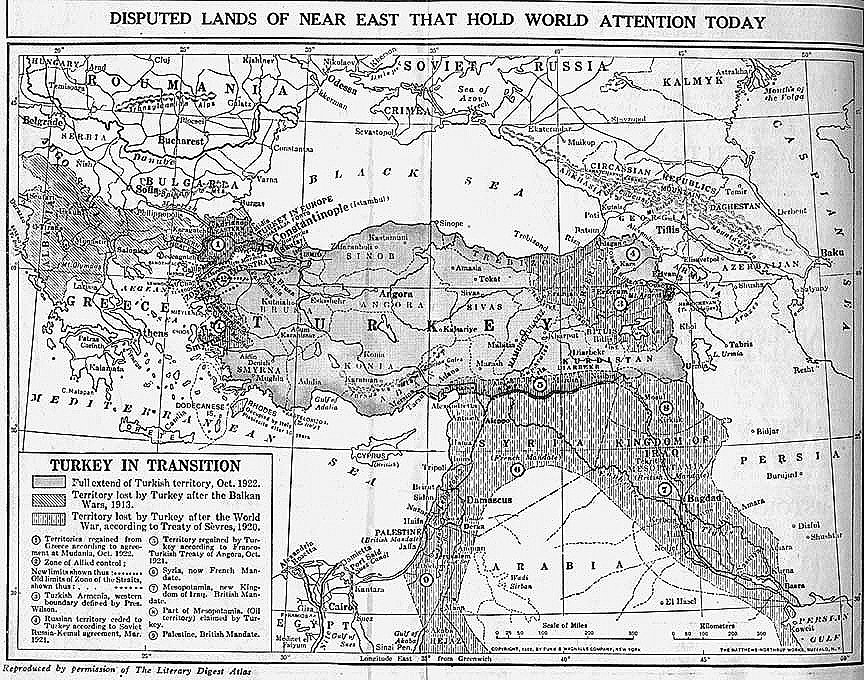
The difference is moral, not just political. His โ€œarchitecture of peaceโ€ is built on the ruins of accountability, where war criminals are statesmen and occupied peoples are told to be grateful for reconstruction. If he wants real historical perspective on the will of the people, all he has to do is find the American King-Crane commission report of 1922 and dust it off and read it. History will not remember this as the dawn of renewal, but as the latest chapter in the long struggle between imposed order and authentic freedom โ€” a struggle the peoples of Gaza, Syria, and Lebanon have not yet surrendered, and never will.

5 Best Documentaries I watched in 2023-2024 And You Should

1. The Settlers (inside the Jewish settlements)

Scary look at the mentality of the Jewish settlers in Israel. A Jewish version of ISIS. More dangerously, it has manifested itself today into the burning of villages and killings innocent Palestinians by the settlers in the West Bank in 2023, which then lead to Hamas retaliation on October 7, 2023, and consequently started the Gaza Genocide which is still on going with over 40,000 civilian deaths mostly women and children so far.

It is a must watch to understand the complexity of the region and the mentality of what is forming the State of Israel.

2. Chimp Empire | Mahershala Ali on Netflix

Enter into the world of our closest cousin. We have 98% same DNA. Understanding them is understanding some of our basic instincts. The largest group of chimpanzees ever discovered have built a complex society deep in the forest of Ngogo, Uganda โ€” but ambition and neighboring rivals threaten to destabilize their empire. Narrated by Academy Awardยฎ Winner Mahershala Ali and directed by Academy Awardยฎ winner James Reed, Co-Director of My Octopus Teacher.

3. My Octopus Teacher

A filmmaker forges an unusual friendship with an octopus living in a South African kelp forest, learning as the animal shares the mysteries of her world. Gives you a new perspective to look at all creatures around us at a time of environmental crisis.

4. Lakota Nation vs. United States

A provocative, visually stunning testament to a land and a people who have survived removal, exploitation and genocide โ€“ and whose best days are yet to come.

5. Navalny

Well, he is dead now. But this documentary was made before his mysterious death in a Russian prison. Poison always leaves a trail. The fly-on-the-wall documentary follows Russian opposition leader, Alexey Navalny, through his political rise, attempted assassination and search to uncover the truth.

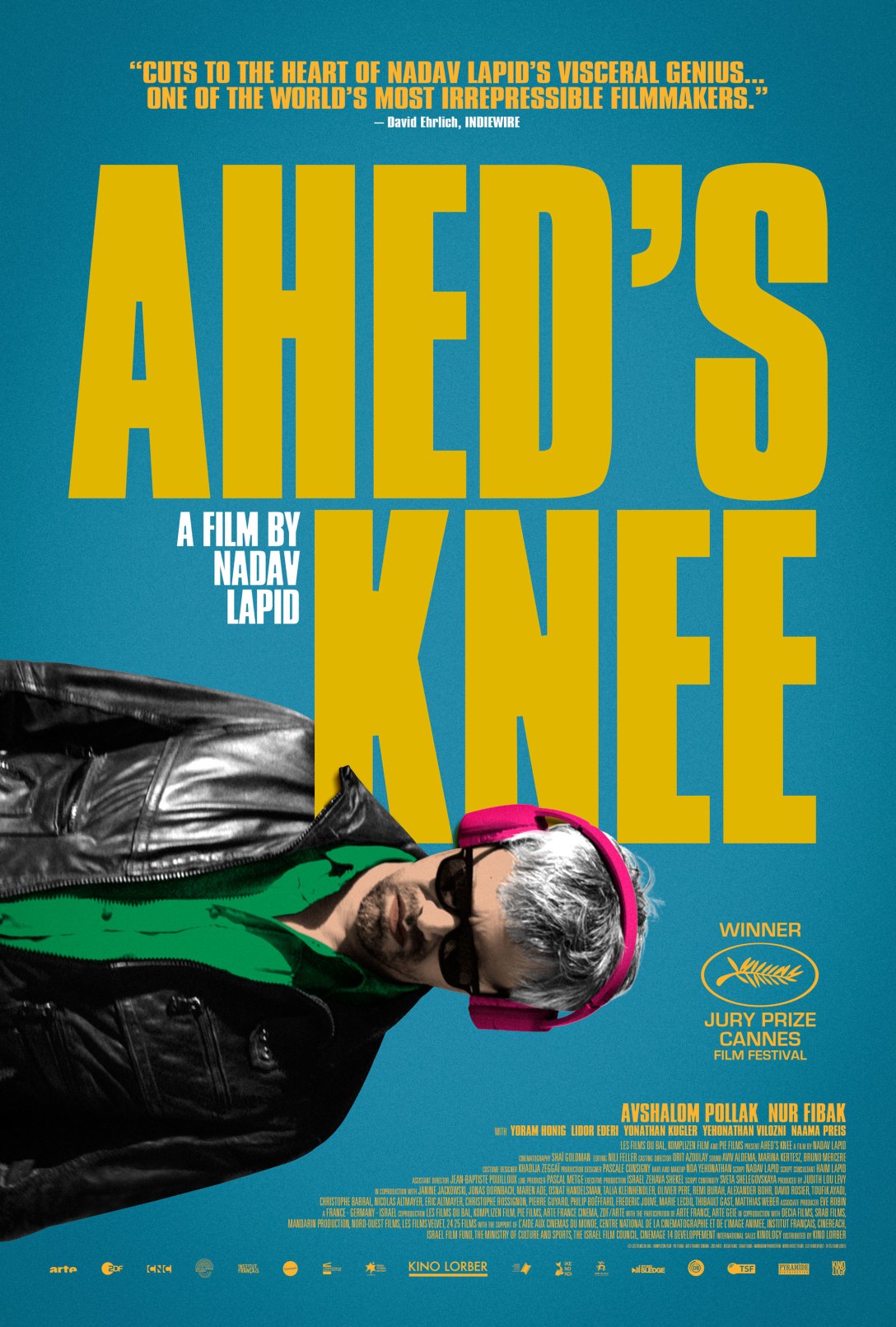
Ahed’s Knee, Stepping Out of the Story

I watched Ahed’s Knee, an Israeli film by Nadav Lapid, a very advanced director whose stories fragment and detour in shocking ways.

Ahed AlTamimi is a teenage Palestinian activist. She was born in 1997 in the village of Nabi Saleh, which is located in the occupied West Bank. Her family has been involved in resistance against the Israeli occupation for years and she has been participating since she was a little girl.

In December 2017, Ahed slapped an Israeli soldier who was guarding her house. The incident went viral on social media and led to Ahed being arrested by Israeli authorities and put into prison for eight months.

An Israeli member of Parliament suggested she be shot in the knee. The film starts focused on producing a show about Ahed’s Knee and then becomes more about the director’s journey and censorship in showing his film.

The film starts focused on producing a show about Ahed’s knee, but quickly evolves into an exploration of the decay of Israeli society and the rise of censorship as a way to protect such a decaying society.

Numerous dance scenes show the randomness of cultural production and arbitrariness of censorship. It is also a surreal representation of the different facets of Israeli society. The director here is making serious subjects not serious by using dance to represent them.

The camera is hijacked later by a monologue that I saw as a way for the director to speak to the government and through it to the Israeli people.

The film disintegrates and questions the concept of negative aggrievement, toxic tensions, oppressive systems, irrational censorship, and through the desert settings, the emptiness at the end of this whole project called Israel.