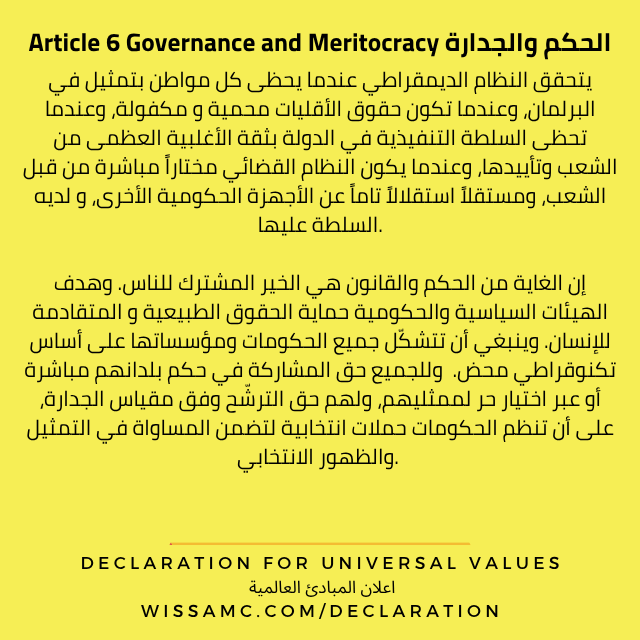
Article 6 – Governance and Meritocracy

A Democratic system is achieved when every citizen has representation in the parliament, minority rights are protected, executive branch has an overwhelming support of the people, and judicial system is directly elected by the people, and completely independent from other branches of government, and has jurisdiction over them.

The purpose of governance and law is the collective well being of humans. The aim of every political association is the preservation of the natural and imprescriptible rights of Man. All governments and their institutions should be established with a technocratic approach.   Everyone has the right to take part in the government of his country, directly or through freely chosen representatives, and the right for nomination based on meritocracy, and governments shall regulate election campaigns to ensure equality in representation and exposure of candidates. 

A truly democratic system is realized when every citizen has meaningful representation in the legislative body, minority rights are effectively protected, and the executive branch enjoys broad, sustained support from the people. In such a system, the judiciary is directly elected by the people, fully independent from the other branches of government, and empowered with legal authority over them to ensure accountability and the rule of law. The purpose of governance and legal institutions is the collective well-being of humanity, and the primary aim of any political association is the protection and preservation of the natural, inherent, and inalienable rights of every person.

In our community of Livonia, Michigan, democratic governance means that every resident has a real voice in the institutions that shape daily life: City Council, School Boards, local boards and commissions, and neighborhood bodies. A healthy local democracy doesn’t just count votes; it ensures that families, workers, renters, homeowners, immigrants, youth, seniors, and minority communities are genuinely represented in public decision-making. For Livonia, this means building systems where city leadership reflects the diversity of the people who live here, where the executive functions of local government are accountable to broad public support, and where our courts and legal processes are independent, transparent, and accessible to all.

All institutions of government should be organized on a technocratic and meritocratic basis, where knowledge, competence, and expertise guide decision-making. Every individual has the right to participate in the governance of their country, directly or through freely chosen representatives, and to seek public office on the basis of merit. To safeguard fairness and equal opportunity, governments must regulate electoral campaigns so that all candidates receive equitable access to representation, visibility, and public platforms, ensuring that political competition reflects ideas and qualifications rather than wealth, privilege, or entrenched power.

The purpose of governance in Livonia is the collective well-being of its residents: safe streets, fair policing, strong public schools, accessible parks and libraries, and an economy that allows people to live with dignity. Every board appointment, staff position, and public office should lean toward meritocracy and technocracy—choosing people based on competence, integrity, and expertise, not on personal connections or partisan favoritism. Every Livonian has the right to take part in public life, whether by running for office, serving on commissions, or participating in open meetings. Local campaign rules and practices should move toward equalizing access—so that a teacher, nurse, or small business owner has a fair chance to be heard alongside well-funded interests. In applying Article 6 here at home, Livonia becomes not just a place we live, but a community we actively co-govern.
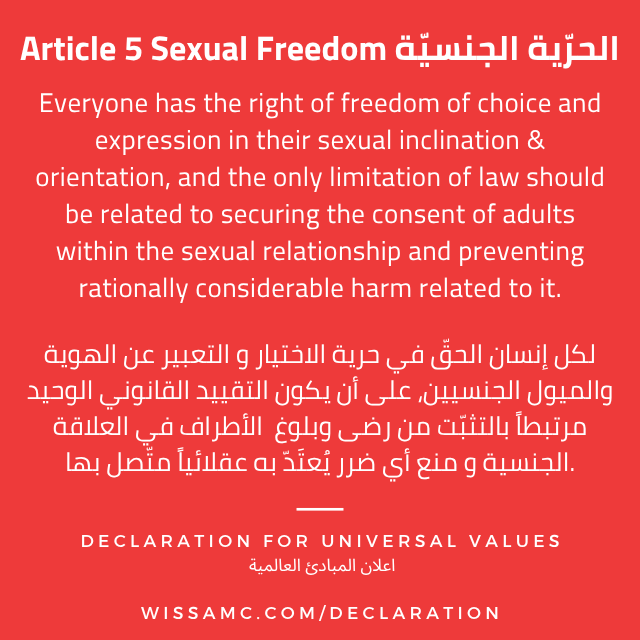
Article 5: Sexual Freedom

Article 5: Sexual Freedom – Everyone has the right of freedom of choice and expression in their sexual orientation, and the only limitation of law should be related to securing the consent of adults within the sexual relationship and preventing rationally considerable harm related to it to citizens and to society.

Article 5 is simple: the state should be a referee, not a roommate. Adults who give informed, voluntary consent—and who aren’t harming anyone—should be left alone by the law. That’s not culture-war fireworks; that’s limited government with a backbone. If we defend freedom of worship, speech, and association from state micromanagement, we should be consistent and defend private, adult relationships that clear the same bar.

Consent here isn’t a shrug; it’s architecture. Adults only. Informed, voluntary, and capable—no coercion, no grooming, no fraud, no power-play that makes “yes” meaningless. The other guardrail is preventing real, demonstrable harm: assault, exploitation, trafficking, blackmail, non-consensual images. Draw those lines bright, enforce them hard, and we protect what matters: the vulnerable, the integrity of commitments, and the peace of our homes.

This approach strengthens families and preserves religious freedom. Churches, synagogues, and mosques remain free to teach and bless—or not—according to conscience. The civil law stays humble: punish force and fraud, respect private adult choices. That’s moral federalism, not moral relativism—one civil standard for everyone, and many voluntary moral codes within our communities.

Scientific research has played a role in challenging earlier views that considered non-heteronormative orientations as pathological. Advances in psychology and understanding of sexual orientation have contributed to recognizing it as a natural and diverse aspect of human identity.  Professional organizations such as the American Psychological Association and the World Health Organization have depathologized homosexuality and emphasized the importance of respecting sexual orientation as a fundamental aspect of an individual’s identity. 

Treating homosexuality like a contagion misunderstands both science and kids. Decades of research in psychology and pediatrics show that sexual orientation isn’t learned by exposure any more than left-handedness is picked up by sitting next to a southpaw; it’s a stable trait shaped by a mix of biology and development, not by classroom mentions or a neighbor’s marriage. What children do absorb from adults is whether the world is safe, honest, and fair. A conservative society that prizes family strength and personal virtue should focus on shielding kids from real harms—coercion, exploitation, bullying—not from the existence of people who are simply different. Teaching respect doesn’t “turn” anyone; it teaches our sons and daughters how to be decent. 

If we can agree that adults must be free, children must be safe, and predators must be stopped, then we already agree on the heart of Article 5. The rest belongs to families, faiths, and the quiet dignity of conscience—a Michigan kind of common sense that guards liberty without losing sight of responsibility.

Article 4 Freedom of Religion: Defending not only the dignity of the believer—but the humanity of the doubter

.FridayMusings is pleased to provide our readers with Article 4 – Freedom of Religion from the Universal Declaration of Human Values by Wissam Charafeddine, a Livonia author and lecturer. This article is particularly important with its discussion of defending the dignity of the believer–but the humanity of the doubter.Everyone has the right to freedom of thought, conscience and religion; this right includes freedom to change or disavow his religion or belief, and freedom, either alone or in community with others and in public or private, to manifest his religion or belief in teaching, practice, worship and observance. 


With over 4300 religions in the world, over 32,000 Christian denominations, 10’s of thousands of Muslim and Jewish sects and schools of thought and over a trillion Hindu and Budhist Gods, the freedom to believe—or not to believe—is one of the most sacred rights a human being can possess. Article 4 of the Universal Declaration of Human Values affirms that and includes the right to change or disavow one’s religion, and to practice, teach, and express belief—either alone or with others, in private or in public. These freedoms protect not just religious devotion, but the autonomy of the soul and mind.This article is rooted in Article 18 of the Universal Declaration of Human Rights, drafted after the horrors of global religious persecution and war. It reflects centuries of philosophical struggle: from Locke’s Letter Concerning Toleration, which argued that faith must be free of state control, to the Enlightenment thinkers who demanded reason over dogma. It also draws from the painful lessons of the Reformation, the Inquisition, and countless modern-day examples where individuals have been punished—or killed—for their beliefs, conversions, or criticisms of religious authorities.


Today, religious freedom is still under siege around the world. Apostates and freethinkers are imprisoned or executed in several countries. In others, entire religious communities face systematic discrimination—whether it’s Uyghur Muslims in China placed in camps, Christians attacked in India, or Baha’is denied citizenship rights in Iran. Even in so-called democracies, laws exist that blur the line between blasphemy and dissent, making it dangerous to question mainstream religious narratives. As someone who has exercised this right by publishing my Arabic-language book Dialogue: Universe from Void—a respectful but direct critique of classical proofs of God’s existence—I recognize that this freedom is not guaranteed everywhere. My ability to speak, write, and reflect on these matters without fear is a privilege many still do not have.


True freedom of religion includes the freedom to search, to question, to leave, or to reform. It includes the right to be silent, and the right to speak. Without that, belief becomes coercion, and conscience becomes property of the state or the mob. In defending this right, we defend not only the dignity of the believer—but the humanity of the doubter.