
Category: Journal
Blueprint or Band-Aid? Why Thomas Barrack’s “Levant Peace” Pitch Misses the Mark
Who Is Tom Barrack, and Why His “Levant Peace” Vision Matters Now
Thomas J. Barrack Jr. is not a diplomat by training, nor an academic specialist in Middle Eastern affairs. He is a billionaire real-estate investor, founder of Colony Capital, longtime confidant of Donald J. Trump, and one of the architects behind the Trump Administration’s Middle East economic agenda during its first term. In Washington and Riyadh circles he is often described as a bridge-builder between American capital and Gulf monarchies, a man who speaks the language of both high finance and regional power.
Barrack’s latest essay, “A Personal Perspective – Syria and Lebanon Are the Next Pieces for Levant Peace,” published in mid-October 2025, positions him as an unofficial herald of the Trump-era return to Middle Eastern grand strategy.¹ The article praises the October 13 Sharm el-Sheikh summit—where world leaders endorsed President Trump’s “Twenty-Point Vision” for renewal and reconstruction—as a turning point toward what Barrack calls an “architecture of peace.” In his telling, the Gaza ceasefire was merely the overture; the next movements are the stabilization of Syria and the disarmament of Hezbollah in Lebanon.
Politically, his piece lands at a charged moment. The Trump administration, restored to power after the 2024 election, has revived the Abraham Accords framework and expanded it into a broader “Levant Peace Initiative,” aimed at drawing Syria, Lebanon, and eventually Iraq into normalization with Israel. At the same time, Washington has begun to roll back sanctions on Damascus, arguing that the “new Syrian government” formed in December 2024 warrants economic reintegration.² Meanwhile, U.S. and French envoys are pressing Beirut to curb Hezbollah’s influence and accept a phased disarmament plan linked to Gulf reconstruction aid.³
Barrack casts these developments as historic progress: sanctions transformed into investment, militias replaced by “legitimate forces,” and regional alignment against Iran framed as moral renewal. He praises Congress for moving toward repeal of the Caesar Syria Civilian Protection Act and urges Lebanon to “align with the anti-terrorist rhythm of its region.”⁴
The subtext, however, is unmistakably political. His essay serves as a soft-power extension of the Trump administration’s broader project—using economic incentives and normalization deals to reshape the Middle East without addressing the root causes of instability: occupation, inequality, and foreign interference. In this light, “Levant Peace” reads less like a diplomatic blueprint and more like a shareholder’s prospectus for a new U.S.-led regional order.
From our Arabic perspective — grounded in the principles of human dignity, honor, and sovereignty, anti-imperialism, and self-determination — Tom Barrack’s piece is an elegant mask on a deeply colonial argument. It recycles the same logic that has long underwritten Western interventions in the Middle East: that peace can be engineered from Washington or Tel Aviv, that Arab nations must “prove” their modernity by aligning with American-Israeli strategic goals, and that sovereignty is a gift bestowed from the outside rather than a right defended from within.
Barrack’s prose is honeyed, but the poison is in the premise. Let’s take it apart.
1. The “Trump Doctrine” as benevolent empire
Barrack frames Trump’s “twenty-point plan” as a renewal of the region — a “bold vision” replacing “fear with optimism.” Yet, in practice, this “vision” mirrors the logic of the Abraham Accords: peace without justice, normalization without liberation, reconstruction on the skulls of children. The Palestinians, whose dispossession is the moral and political nucleus of the region’s conflict, are reduced to scenery in a Trumpian tableau of “prosperity.”
He claims Gaza’s ceasefire marks the start of a “mosaic of partnership,” but ignores the grotesque asymmetry of power at play: With about 200,000 tons of explosives… equivalent to 13 nuclear bombs, Gaza was bombed into submission , not invited into cooperation. To praise “peace through shared opportunity” while hundreds of thousands remain displaced, starved, or buried under rubble, is to mistake silence for harmony.
This is not diplomacy — it is damage control for genocide, ethnic cleansing, and war crimes dressed in corporate language.
The first item of business is to set war crime tribunals and arrest Netenyahu. Is to stop the famine and reduce the risk of death for the 100’s of thousands of children, women, and men of Gaza. Is to provide shelter, and bury the dead, and bring healthy water and medicine. Is to release all palestinian hostages that are being raped and tortured, eyes blinded with electricity, legs amputated after torture, and faces implanted with the israeli version of swastikas. There is no diplomacy amidst a Genocide unless you count Arabs as you counted buffalos in the newly discovered Turtle Island.
2. Syria: Sanctions are not the central problem — sovereignty is
Barrack’s call to repeal the Caesar Act seems, on the surface, humane. Indeed, U.S. sanctions have crippled civilians far more than elites, and ending them could be a step toward recovery. But Barrack’s reasoning is not humanitarian; it’s transactional. He describes the repeal as “strategy,” a way to “unlock investors,” “unleash reconstruction,” and “signal to allies.” In other words, he wants Syria reopened to Western and Gulf capital — not to Syrian agency.
When he praises the “new Syrian government” that arose after December 8, 2024, he treats it as if Damascus were rebooted like a corporate board, conveniently absolving the same foreign powers who weaponized sanctions and proxy wars in the first place. True recovery cannot come from conditional Western “partnerships” tied to alignment with Israel’s regional framework. It must come from the Syrian people determining their political future free of imperial bargaining.
Also, there is total ignoring of the war crime of an expanded occupation of Syria in 2024. Barack didn’t mention the grave breaches of international humanitarian law, specifically the Fourth Geneva Convention, nor the war crime of forced displacement of Syrian civilians from their homes (prohibited under Article 49 of the Fourth Geneva Convention), the extensive and unjustified destruction and confiscation of civilian property and agricultural land not required by absolute military necessity, and the unlawful transfer of Syrian detainees into Israeli territory. Furthermore, the establishment of permanent military control and the stated intent to hold the territory indefinitely violate the principle that occupation is a temporary state and that acquiring territory by force is illegal under the UN Charter, with such actions also potentially amounting to a crime of aggression.
Golan Heights which has been since 1967 under long-standing occupation covers about 1,200 sq km (460 sq mi), but since the collapse of the Assad regime in December 2024, Israel has expanded its control into the UN Disengagement Observer Force (UNDOF) buffer zone and surrounding parts of the Quneitra and Daraa governorates with an incursion zone reaching approximately 600 sq km. This expansion has brought the total occupied Syrian land mass to well over 1,700 sq km, which is almost triple the size of the country of Bahrain.
3. Lebanon: A sovereign nation, not an Israeli security project
Barrack’s prescription for Lebanon is the most revealing — and the most dangerous. He calls Hizballah’s disarmament “Lebanon’s opportunity for renewal,” framing it as both an Israeli security need and an American economic incentive. He argues that U.S. and French “oversight” of Lebanese reconstruction, tied to disarmament, is a path to sovereignty. This is doublethink.
No genuine sovereignty can coexist with conditions imposed by foreign powers. To demand that Lebanon “align with the anti-terrorist rhythm of its region” — meaning, align with U.S. and Israeli military objectives — is to erase the country’s complex pluralism and replace it with a single acceptable rhythm: obedience.
The core of Lebanon’s paralysis is not Hizballah alone but the continuous and daily state terrorism practiced by Israel on South Lebanon since 1978, including 4 invasions one of which took over the Capital city of Beirut, and the sectarian system created by French colonial design, sustained by Saudi and Western patronage, and manipulated by Washington whenever convenient. To single out Hizballah’s weapons as the cause of all Lebanese decay is a false simplification. The real question is why the U.S. and its allies continue to block Lebanon’s economic recovery and political reform unless it conforms to Israel’s definition of “peace.”
4. Iran as eternal villain
Barrack’s essay requires a perpetual antagonist — and Iran fits perfectly. He paints the Islamic Republic as “terminally weakened, morally bankrupt, and treacherous,” a kind of necessary evil whose eradication justifies every American maneuver. This caricature allows him to frame Trump’s peace plan as anti-terrorism rather than anti-sovereignty. Yet the reality is that Iran’s influence in the Levant exists largely because of U.S. and Israeli wars that shattered Iraq, strangled Syria, and left power vacuums across the region. Iran’s influence in Lebanon, in many respects, grounded in legitimate social and political realities inside Lebanon itself. It cannot be reduced to an external “imposition” or mere “proxy control.” For a large portion of the Lebanese population — particularly within the Shiite community that constitutes roughly a third of the country — Iran’s relationship with Lebanon represents both protection and empowerment in a political system historically designed to marginalize them.
After decades of neglect by Lebanon’s post-colonial elite and repeated Israeli invasions, Iran’s alliance with Hezbollah offered something no other foreign or domestic actor did: effective resistance, social infrastructure, and dignity for the country’s poorest and most war-torn regions. The relationship that developed between Iran and Hezbollah after Israel’s 1982 invasion was not forced upon Lebanon; it was welcomed by communities who had lost faith in a fractured central government and in Western powers that had consistently backed aggressors rather than victims.
Beyond military capacity, Iran’s role has included financing hospitals, schools, reconstruction projects, and fuel shipments during Lebanon’s 2021 energy crisis — tangible support that many Lebanese citizens experienced directly while their own government remained paralyzed. These initiatives built a popular base that sees the Iran-Hezbollah axis not merely as a foreign extension of Tehran’s power, but as a domestic safety net and political voice in a deeply unequal system.
It’s crucial to remember that Hezbollah is not just an armed group; it is a major political party with elected representatives, cabinet ministers, and alliances that stretch beyond sectarian lines. While its military role remains controversial even within Lebanon, its social and political legitimacy is undeniable. Its partnership with Iran has sustained it, but it is Lebanese society itself — through votes, volunteer networks, and grassroots institutions — that continually renews that legitimacy.
To frame Iranian influence as inherently destabilizing is to ignore that it emerged as a response to repeated foreign invasions, Western-backed isolation, and a state that failed to provide basic security and equality. For many Lebanese citizens, the Iran-Hezbollah relationship embodies self-defense, sovereignty, and resistance to hegemony — values deeply resonant across the Arab world today.
In short: Iran’s influence in Lebanon, while not universally supported, is not simply manipulation from abroad. It reflects the lived experiences and aspirations of a significant portion of the Lebanese population who view resistance not as extremism, but as survival — and sovereignty not as alignment with Washington, but as freedom from domination in all its forms.
One cannot destroy the neighborhood, then blame the neighbors who pick up the pieces.
5. The myth of economic salvation
Barrack repeatedly equates “commerce” with peace, insisting that trade and investment are “the bridge from conflict to coexistence.” But this assumes that inequality and occupation can be cured by capital influx. In truth, economic integration without justice only cements dependency. The same logic built the neoliberal disasters of post-war Iraq and the failed privatization experiments in Egypt.
When capital comes before dignity, reconstruction becomes recolonization — a process where the same foreign investors who financed wars profit from rebuilding what they destroyed.
6. Peace without liberation is submission
Barrack’s final flourish about a “renewed mosaic” and “century of conflict giving way to cooperation” is poetic theater. What he calls “cooperation” is, in reality, normalization with apartheid and alignment under U.S. hegemony. He confuses pacification for peace. The Green Party, human rights advocates, and the Arab peoples themselves see through this. Real peace requires equality before the law, not equality before the dollar.
A Syria or Lebanon that kneels before Washington’s “prosperity plan” is not reborn — it is re-colonized.
7. Our perspective: sovereignty and justice first
From the standpoint of those committed to human rights and anti-imperial values — whether Greens, progressives, or Arab humanists — Barrack’s thesis collapses on two fronts:
- It assumes U.S. leadership is the indispensable architect of Middle Eastern peace, when in fact it has been the principal architect of its instability.
- It ignores that liberation movements, from Palestine to Lebanon, arise not from “terrorism” but from decades of dispossession, occupation, and foreign interference.
Repealing sanctions might indeed help Syrians — but only if coupled with genuine political autonomy, not as a prelude to new American control. Disarming Lebanese factions might indeed serve stability — but only if done by consensus within Lebanon, not at Israel’s demand.
Barrack wants a Levant pacified for investment. We want a Levant liberated for self-determination.
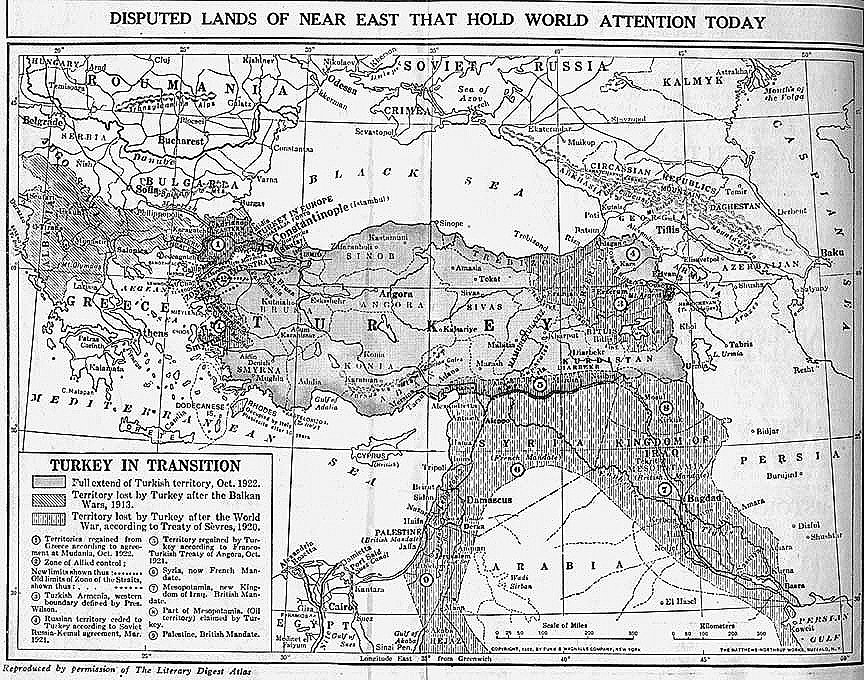
The difference is moral, not just political. His “architecture of peace” is built on the ruins of accountability, where war criminals are statesmen and occupied peoples are told to be grateful for reconstruction. If he wants real historical perspective on the will of the people, all he has to do is find the American King-Crane commission report of 1922 and dust it off and read it. History will not remember this as the dawn of renewal, but as the latest chapter in the long struggle between imposed order and authentic freedom — a struggle the peoples of Gaza, Syria, and Lebanon have not yet surrendered, and never will.
هل تتفق مع أيديولوجية الحزب الأخضر؟ وسام شرف الدين
أحداث غزة هي التي دعتني للانخراط بالعمل السياسي في أميركا ـ وسام شرف الدين
وسام شرف الدين من العمل الثقافي إلى العمل السياسي … لماذا؟
Revolutionizing Democracy: The Power of Ranked Choice Voting rankmivote.org
تحية حب وتقدير للأستاذ أسامة السبلاني ـ وسام شرف الدين ـ المركز العربي الأميركي للثقافة والفنون
التهميش المتعمد للحزب الأخضر من الإعلام والسياسة الأمريكية ـ وسام شرف الدين
Article 5: Sexual Freedom
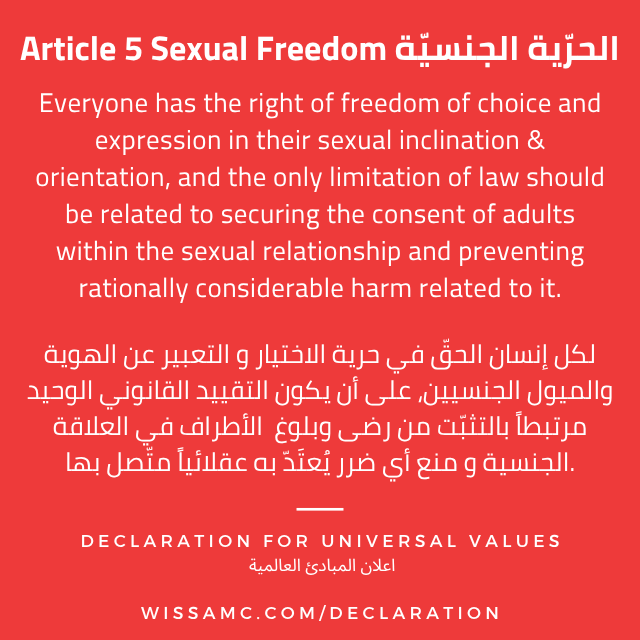
Article 5: Sexual Freedom – Everyone has the right of freedom of choice and expression in their sexual orientation, and the only limitation of law should be related to securing the consent of adults within the sexual relationship and preventing rationally considerable harm related to it to citizens and to society.
Article 5 is simple: the state should be a referee, not a roommate. Adults who give informed, voluntary consent—and who aren’t harming anyone—should be left alone by the law. That’s not culture-war fireworks; that’s limited government with a backbone. If we defend freedom of worship, speech, and association from state micromanagement, we should be consistent and defend private, adult relationships that clear the same bar.
Consent here isn’t a shrug; it’s architecture. Adults only. Informed, voluntary, and capable—no coercion, no grooming, no fraud, no power-play that makes “yes” meaningless. The other guardrail is preventing real, demonstrable harm: assault, exploitation, trafficking, blackmail, non-consensual images. Draw those lines bright, enforce them hard, and we protect what matters: the vulnerable, the integrity of commitments, and the peace of our homes.
This approach strengthens families and preserves religious freedom. Churches, synagogues, and mosques remain free to teach and bless—or not—according to conscience. The civil law stays humble: punish force and fraud, respect private adult choices. That’s moral federalism, not moral relativism—one civil standard for everyone, and many voluntary moral codes within our communities.
Scientific research has played a role in challenging earlier views that considered non-heteronormative orientations as pathological. Advances in psychology and understanding of sexual orientation have contributed to recognizing it as a natural and diverse aspect of human identity. Professional organizations such as the American Psychological Association and the World Health Organization have depathologized homosexuality and emphasized the importance of respecting sexual orientation as a fundamental aspect of an individual’s identity.
Treating homosexuality like a contagion misunderstands both science and kids. Decades of research in psychology and pediatrics show that sexual orientation isn’t learned by exposure any more than left-handedness is picked up by sitting next to a southpaw; it’s a stable trait shaped by a mix of biology and development, not by classroom mentions or a neighbor’s marriage. What children do absorb from adults is whether the world is safe, honest, and fair. A conservative society that prizes family strength and personal virtue should focus on shielding kids from real harms—coercion, exploitation, bullying—not from the existence of people who are simply different. Teaching respect doesn’t “turn” anyone; it teaches our sons and daughters how to be decent.
If we can agree that adults must be free, children must be safe, and predators must be stopped, then we already agree on the heart of Article 5. The rest belongs to families, faiths, and the quiet dignity of conscience—a Michigan kind of common sense that guards liberty without losing sight of responsibility.
Ristorante il Cantuccio Nerano – October 6, 2025

 Wissam Charafeddine